Azaranica is a non-biased news aggregator on Hazaras. The main aim is to promote understanding and respect for cultural identities by highlighting the realities they face on daily basis...Hazaras have been the victim of active persecution and discrimination and one of the reasons among many has been the lack of information, awareness, and disinformation.

Wednesday, April 25, 2012

Tuesday, April 24, 2012

Pictorial Report; Asylum seekers in Indonesia protest against genocide of Hazaras in Quetta, Pakistan

Asylum seekers in Indonesia protests against genocide of Hazaras in Quetta, Pakistan


Pictorial Report; Bamiyan Protests against Hazaras genocide in Quetta, Pakistan

Bamiyan protests as part of worldwide protests against genocide of Hazaras in Quetta, Pakistan


Labelled as “infidels”, minority Shiite group tracked down and killed in Pakistan


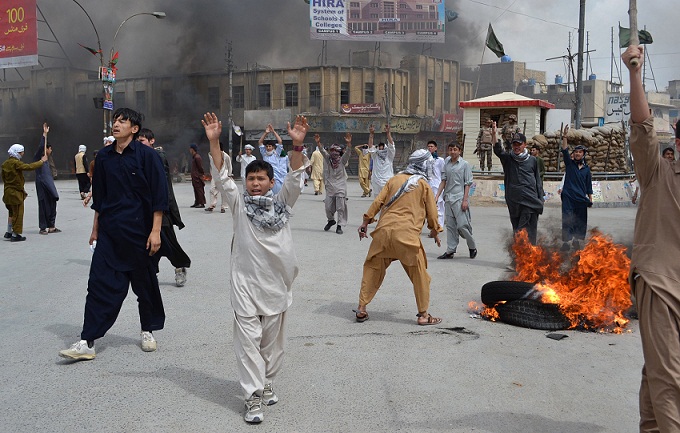
Hazara womend protest in Quetta on April 19. Photo by our Observer, Basit Ali.

The simple act of walking in the streets of Quetta, the capital of Pakistan’s western Balochistan province, can have deadly consequences for the city’s Hazara community. The Hazaras, who are predominately Shiite Muslims, have been labelled “infidels” by extremist Sunnis, who hold a significant amount of power in the region. For the past 20 years, our Observer has lived with the daily threat of violence because of his religion – a threat that claimed the life of one more victim just this Monday.

Monday’s death came on the heels of a terrorist attack on Saturday, April 14, which left nine Hazaras dead. The act was claimed by Pakistan’s extremist Lashkar-e-Jhangvi, a group with ties to both the Taliban and al-Qaeda, which has targeted the region’s Hazara population. Just one week before, religious violence claimed the lives of nine other Hazaras....Continue Reading.... 

Pictures of target killer hunted by Police in Quetta, Pakistan

The spokesperson of terrorist organization Lej who were involved in target killings were killed in a crossfire with Police in Quetta. 

Quetta in focus: Police hunt down ‘two target killers’


By Shehzad Baloch
Published: April 24, 2012


CM Raisani announces half a million rupees for the police. PHOTO: FILE
QUETTA:

The city police killed two alleged target killers in an encounter near the Akhtarabad neighbourhood of Hazara Town on Monday. A police official was also injured in the clash.

Chief Minister Nawab Aslam Raisani announced half a million rupees for the police party which took part in the operation, in addition to promising them a promotion to next rank.

Narrating details, Deputy Inspector General (DIG-Operations) Qazi Wahid said that the police signaled a car to stop near Akhtarabad for a routine search. However, the car tried to speed away, arousing suspicion. After a brief chase the police called in the Anti Terrorism Force (ATF).

The alleged militants travelling in the car opened fire at the police, critically injuring Constable Riaz. Police retaliated and in the ensuing firefight two militants were killed.

“Police have recovered six pistols, including 9mm pistols, a Russian-made grenade, seven fake registration numbers and two National Identity Cards (NICs) from the militants,” said Qazi.

‘Nefarious designs’

The bodies were later shifted to Bolan Medical Complex (BMC) for autopsy. The identity of the suspects could not be determined as investigations were still under way.

“They were target killers, who wanted to target more people in Quetta” asserted DIG Qazi.

Responding to a query, he said the recovered ID cards were either fake or seemed to have been stolen and had been sent to the National Database and Registration Authority (NADRA) for verification.

Six target killers have so far been arrested by the law enforcement agencies in Quetta, after strict security measures were put in place in the aftermath of the recent targeting of the Hazara community.

Published in The Express Tribune, April 24th, 2012.

Connection Between the Pakistani Military And Hazara Killings in Quetta


By Amjad Hussain

“I dont hold anybody responsible for the brutal murder of my sister, but the provincial government and the Pakistani military spy agency, ISI”, says Yazdan Salimi, a young Hazara man whose sibling was among the victims of March 29 terrorist attack in Quetta on a Suzuki van carrying Hazara commuters from one part of the capital city to another.

“People at the helm of affairs in the North Western Balochistan province of Pakistan need to be brought to dock and made accountable for their failure to provide security to ethnic Hazara minority in the capital city”, adds Salimi who is one of the thousands of the Hazara asylum-seekers who have left the Pakistani city of Quetta to take refuge in Australia due to fear of ethnic and religious persecution. Salimi mourned the death of his sister in an Australian detention centre for asylum-seekers with great despondency as he feels sorrow for being unable to see the dead face of the victim before she was laid to rest.

Like Salimi, there are hundreds of other bereaved Hazara families who have lost their loved ones in the terrorist attacks in Quetta over the the past fourteen years. These families are still waiting for the perpetrators to be nabbed and convicted. But, for them, it seems to be a forlorn hope as the government of the day in Pakistan is still unwilling to act effectively to preclude what most of the members of the affected community describe as the “systematic genocide of the Hazaras”....Continue Reading....

Monday, April 23, 2012

PkMAP protests against targetkillings in Quetta


Muhammad Ejaz KhanTuesday, April 24, 2012

QUETTA: The office bearers and activists of the Pakhtunkhawa Milli Awami Party (PkMAP) took out a protest rally in the provincial capital on Monday against the target killings of members of the Hazara community in Quetta. They also denounced the killings of Pashtoons in Karachi.

The protest rally, led by provincial president of PkMAP Usman Khan Kakar, Dr Hamid Khan Achakzai, Abdul Raheem Khan Ziaratwal and others, was taken out from the central secretariat of the PkMAP and marched through various roads and streets of the city. The protestors carried out placards and banners inscribed with slogans ìstop target killings at Quetta and Karachiî.

The protestors chanted slogans against target killings and failure of the Balochistan government, demanding immediate arrests of the culprits involved in the heinous crime. One of the slogans inscribed on a banner was “Provide us security and restore peace of Quetta and Karachi”.

The protest rally of PkMAP later turned into a public meeting at Bacha Khan Chowk where the leaders of the PkMAP strongly condemned the killings of innocents people at Quetta and Karachi and demanded of the government to provide them security. They observed that the government was oblivious about the gravity of the situation, while the target killers were playing havoc on the city’s roads, they remarked.

The held the federal and provincial governments responsible of the killings of innocents people and demanded that the government should fulfill its constitutional obligations. If the government could not provide security to the life and property of the citizens then the people would be left with no other option but to press the government to step down, they added.

The leaders of the PkMAP asserted that the Pashtoons had always rendered greats sacrifices and foiled the nefarious designs and added that the Pashtoons had defeated the designs whenever conspiracies had been hatched for extremism, terrorism and sectarians.

Police shoot dead ‘two sectarian killers’ in Balochistan


Protest against target killning of hazaras in Pakistan- Malmö sweden. ma...

Who is the real enemy of Pakistan? (Urdu)

Sunday, April 22, 2012

Hazara man shot at, injured in Quetta


Monday, April 23, 2012  

QUETTA: A man belonging to the Hazara community was shot at and injured on McCongy Road on Sunday in what appeared to be another case of violence against Shias. According to police, the victim, identified as Sajjad Ali, was on his way when assailants on a motorbike opened fire on him. He sustained injuries and was rushed to Combined Military Hospital (CMH) for treatment. “The victim was a Shia Muslim and a resident of Marriabad on Alamdar Road, a Hazara dominated neighbourhood,” sources said. Despite strict security measures adopted by the government, sectarian attacks in the city continue unabated. staff report

Protest against target killning of hazaras in Pakistan- Malmö Sweden- Dr...

Hazara people are no aliens; Tariq Baloch


From the Newspaper 

THIS is with reference to Irfan Hussain’s eye-opening letter (April 18) in which he has rightly explained the agony of the ethnic community in Balochistan.

Hazaras claim their legacy to 13th century warrior Changez Khan; therefore, they add the title ‘Changezi’ with their names.

The community has been continuously migrating from Afghan province Bamian and its surroundings, in the north of Kabul, where they held ancestral land all the way up to Balochistan.

The first blow came to them when Khan Abdur Rehman of Kabul started butchering them on sectarian grounds in the late 19th century.

Major groups started settling in parts of Balochistan. However, several families migrated during the 1960s and 1970s. The migration still continues as families are moving to Karachi and abroad.

As an enterprising and united community, they have excelled in major services and business opportunities in the last 30 years or so. General Musa Khan is an example who remained Governor of Balochistan for many years. I can remember my childhood days of the late 1980s when I saw this gentleman walking alone along Zarghoon Road. This was his simplicity and genuineness as he was also a tribal elder. He was a jewel of Balochistan.

The Hazara community enjoys good relations with the Pashtun and especially with the Baloch due to their linguistic similarities.

The only negative events I remember were the July 1984 one (where the Hazara were entangled with police and FC) and the one in the 1990s in which it had a conflict with Pashtun groups.

It is difficult to ascertain any responsibility on any one group for both events, as some foreign hands were playing their games in those times and still do.

Although the Balochistan government is incapable of staving off conflict due to corruption, I still see a foreign hand in the situation faced by the Hazara in Balochistan. The Hazaras are jewels of Balochistan and sons of the soil.

I request the authorities concerned to take stringent action against sectarian groups.

TARIQ BALOCH
Karachi

Saturday, April 21, 2012

Persecuted Hazaras rally for peace

At least 29 Hazara Shias have been killed and scores wounded in Quetta in the last two weeks, in the recent spate of violence against the minority community. Last week, thousands of people gathered in the capital of the Balochistan province to protest against yet another surge in sectarian violence.

The April 13 protests, organized by the Hazara Democratic Party, were called after four people were killed in two separate attacks on Iqbal Road and Abdul Sattar Road in Quetta on April 12.

Thousands of people from the Hazara ethnic minority community were chanting slogans against the local government and law enforcement agencies demanding a crackdown on terrorist groups who were targeting the 600,000 Hazaras of Quetta. Protesters also called for increased government protection for the predominantly Shia Muslim community...Continue Reading...

Crime Scene Apr 18, 2012 SAMAA TV 1/2

Quetta: 2 Hazara men killed; FC nabs attackers after a chase

Updated on: Saturday, April 21, 2012 2:09:41 PM


Staff Report
QUETTA: At least two people hailing from Hazara community of the city, were killed in a firing incident this morning near TB Sanatorium at Barori Road, SAMAA reports Saturday.

According to the FC sources, some miscreants gunned down two Hazara people near TB Sanatorium on Barori Road this morning.

The FC personnel soon arrived on the spot and gave the running saboteurs chase. Unable to steer clear of the forces, the miscreants tried to take shelter in nearby houses; however, they were caught up by the FC men, who arrested them along with the firearms.

The miscreants were handed to police for further interrogations.

According to the FC spokesman, eyewitnesses also identified the three captured miscreants. SAMAA

کوئٹہ میں ہزارہ برادری کے دو افراد قتل؛ تین ملزمان اسلحہ سمیت گرفتار


Updated on: 1:37:15 PM ہفتہ, 21 اپریل 2012


اسٹاف رپورٹ
کوئٹہ: شہر میں ہزارہ برادری کے دو افراد کے قتل کے واقعہ کے بعد ایف سی نے تعاقب کرتے ہوئے تین ملزمان کو اسلحہ سمیت گرفتار کرلیا۔۔

ایف سی ترجمان کے مطابق، بروری روڈ پر ٹی بی سینیٹوریم کے قریب نامعلوم افراد نے فائرنگ کرکے دو افراد کو قتل کردیا تھا۔

واقعہ کے بعد ایف سی کے اہلکار موقع پر پہنچ گئے اورملزمان کا تعاقب کیا جنہوں نے قریبی گھروں میں پناہ لینے کی کوشش کی تاہم ایف سی نے انہیں اسلحہ سمیت گرفتار کرلیا اور مزید تفتیش کے لئے پولیس کے حوالے کردیا۔

ایف سی ترجمان کے مطابق گرفتار ہونےوالے تین ملزمان کی عینی شاہدین نے بھی شاخت کی ہے ۔۔ سماء


Under Siege of Terror: The Shia Hazara of Pakistan


Posted by: Rafia Zakaria, April 19, 2012 at 12:04 PM

Amnesty International


Pakistani Shiite Muslims protest after the sectarian killings in Quetta on April 14, 2012. Eight people, including seven Hazara, were gunned down in separate sectarian targeted incidents. (Photo: BANARAS KHAN/AFP/Getty Images)

Sectarian violence promoted by religious extremists is not new to Pakistan, but the latest series of brutal attacks on the otherwise peaceful Hazara people has reached a breaking point in recent weeks. Despite the fact thatnearly 30 people have died in the past two weeks, the Government of Pakistan seems incapable – if not unwilling – to step in to stop this siege of terror.

The situation in the Balochistan province, located in south-west Pakistan has always been complex with a number of different ethnic groups, a seccesionist movement and various Taliban leaders all vying for power. Things have become even worse in the last few years with escalating tensions between the United States and Pakistan over the NATO supply route leading to even more unrest in Quetta, Balochistan’s capital city and bringing an onslaught of tragedy to the Hazara who live there.
For hundreds of years, the Hazara people of Pakistan had lived in the shadows of the low mountains of Quetta. Located on the border between Iran, Afghanistan and Pakistan, the city has always been a crossroads of goods and people. Belonging to the minority Shia sect of Islam and easily distinguishable from the other ethnic groups of the region because of their Central Asian features, the Hazara are an easy target.

In particular, the Lashkar-e-Jhangvi, a sectarian, militant group have been targeting the Hazara minority in Balochistan in a series of brazen attacks. Last September, religious processions organized by the community were targeted twice. Then came the brutal assault on a bus carrying Shia Hazara pilgrims to Quetta. All the men and boys aboard were taken out of the bus, lined up and shot, as their mothers, wives and sisters watched from inside. The assailants were unafraid, and had insured that the highway was blocked on both ends when they conducted that ambush. Later that evening, two more Hazara men were killed after being dragged out of their cars at a traffic light in Quetta. The total death toll for the day was over thirty dead and scores more injured.
The killing has continued since and has taken on a frenetic pace this past week. Since March 26, 2012, nearly 30 people have died in targeted attacks on the Hazara Shia. Six were shot dead execution style while drinking tea at one of the many roadside stalls in Quetta. The attack on March 29, again involved a hijacked bus whose Hazara passengers, including a woman, were singled out and then summarily murdered with automatic weapons.

Recent days have brought even more attacks, with the hapless members of the community taking to the streets of Quetta, before an apathetic provincial administration and the wrath of terrorist groups that can kill with impunity.
According to a report produced by the community, local authorities in Balochistan have taken only superficial measures or none at all to stop the killings or bring their killers to justice. Public religious edicts issued by Lashkar-e-Jhangvi members and labeling the extermination of Hazara as a religious duty continue to be distributed freely in mosques, via handbill and even text message in Quetta.

The volatile mix of apathy and terror is exacerbated by the general unrest and lawlessness in Baluchistan. Unlike other nationalist forces in the province, the Hazara are patriotic Pakistanis unwilling to support any secessionist causes, which makes their situation even more precarious.

In their own words; the Shia Hazara of Quetta are a peace love community under siege from a collusion of forces; the brazen Lashkar-e-Jhangvi whose assailants are killing them at will, an apathetic Balochistan Government that does not see them as worth protecting, and the silence of everyone else who is watching them die.

Lacking political connections, resources and unwilling to take on the same tactics of violence and intimidation used by all those around them; the onlyrecourse that the Hazara of Quetta can hope for is that the world who hears of them, does not think they are too small, too unknown and too helpless to be allowed to exist.

Follow Rafia on Twitter @rafiazakaria

Target killer arrested by Young Hazara Boyzzz.

Latest update from Quetta Pakistan:

Two Hazaras were shot this morning while they were on a bike. One of them died on the spot other was severely injured and was taken to the hospital. After an operation of Pakistani Police and Frontier Corps forces with the help of Hazara Boys, they were able to capture the terrorists while terrorists were trying to escape after committing the murders.

 Just after the incident another prominent political person known as Syed Mohammad Ali among the Hazara neighborhoods of Quetta was ambushed in which he was injured. The Hazara boys have done a great job in assisting the police capture the terrorists. The boys were smart in filming the capture and taking pictures of terrorists while they were being captured. Hats off to you all. There is news that one of the terrorist vanished all of a sudden, other is in local police station of Quetta. Once again, great job Hazara brothers! you are the only hope of our people in Quetta Pakistan.

Samaa TV also reported the incident of arrests

  This is an open question to Security Agencies.... If unarmed young boys can arrest Target Killers red handed, why then security forces have failed to do so for a decade????

Samaa TV; Two more Hazaras Targeted in Brewery Road

Racial hatred, Sectarian Divide and Genocide of Hazaras (Urdu)

This is an interesting piece to learn, how people with religious tendencies look to Hazaras. A pattern that I see again and again (very visible), such people do not see Hazaras as they are. They try to see in them what they see in Iran. This is a Psychological disease that is currently prevailing in Pakistan (This is what happens when one does not try to learn but instead want to see things as he wishes). The perceptions that are constructed on conspiracy theories and are deeply rooted in prejudices fail to replace the history and identity of a nation. Instead of analyzing line b line, I leave that for readers to judge.

And it is what happens when the perception replaces history... 

Minority report


From the Newspaper | Irfan Husain |


A FEW months ago, somebody emailed me a chilling audio clip of a conversation between a journalist and a Pakistani Taliban.

When the interviewer reminded the terrorist that he was a Muslim too, and recited the kalima to prove it, he was told bluntly that the Taliban did not view anybody who did not subscribe to their extreme vision as believers.

When the Taliban was reminded that the founder of Pakistan was a peaceful, tolerant man, he replied that Jinnah had ‘Ali’ in his name, and so must be a Shia. “We do not accept the Shia as Muslims,” he insisted.

From considering the Shia to be non-Muslims, it seems there is only a short step to declaring them wajib-ul-qatal, or deserving of death, preferably by violent means.

Indeed, this extreme view has been around for three decades in Pakistan. The emergence of the Sipah-i-Sahaba Pakistan in the 1980s and later the Lashkar-i-Jhangvi (LJ) saw the beginnings of sectarian bloodshed.

Of course, Shia-Sunni strife is nothing new in Muslim history. From virtually the earliest period of Islam, conflicting claims over the Caliphate have led to the bitter divide that persists to this day. Many of the current conflicts within the Islamic world have their roots in this ancient schism.

The ongoing slaughter of Hazara Shias in Pakistan is yet another reminder of the inhuman nature of extremism. While individual Shias have been targeted for years, the recent mass killings of ethnic Hazaras is probably happening because they can be so easily identified. According to a Hazara website, 700 of the community have been killed in recent years without a single terrorist being brought to justice.

An article ‘Who kills Hazaras in Pakistan and why’ on the webzine Outlookafghanistan.net states:

“Since the declaration of religious extremists as ‘strategic assets’ by the ruling elites of Pakistan, the religious militant groups like Lashkar-i-Jhangvi and the Taliban have been given free hands [sic] to do anything they like.”

The cold-blooded massacres of Shias in Kohistan and Chilas seem to indicate that either the local law-enforcement agencies were asleep or complicit. Gilgit’s lockdown and the evacuation of foreign tourists showed the world yet again what an anarchic and violent place Pakistan has become.

In a recent army-led operation, several of the alleged extremist killers have been arrested, and Shia and Sunni mosques in Gilgit sealed to forestall further tension. But the real test will come when these terrorists are brought to trial: thus far, the record of our judiciary in sentencing such criminals has not been very reassuring.

More often than not, they have been released on bail, or let off on grounds of insufficient evidence. Judges have been reluctant to grasp that witnesses are too scared to come forward. Repeated postponement of hearings also deters people from giving evidence.

Apart from the LJ and the SSP’s anti-Shia violence, the Jundullah is a latecomer to Pakistan’s sectarian slaughter.

Understandably, hundreds of Hazaras have fled, many to Australia. They are only the latest wave of persecuted Pakistanis seeking sanctuary in safer places. Those Christians, Hindus and Ahmadis who could have already left the country Jinnah saw as one where they would have equal rights.

Steadily, the space for anybody not hewing to the mainstream school of Islam is shrinking. Indeed, the Taliban spokesman I quoted earlier was clear that all those who did not actively oppose the state were non-Muslim and therefore wajib-ul-qatal. This is the inexorable logic of the takfiri philosophy that underpins the global jihad: anybody can be dubbed a non-Muslim and thus a target.

Sadly, the response to all this violence among the Pakistani ruling elites remains muted. There is little of the anger directed towards the Americans for the drone attacks that have killed far fewer innocent people than sectarian terror has. And yet, the media, the political class, and civil society seem oddly disconnected with the fate of our unfortunate minorities.

Those Pakistanis who are worried about where their country is headed would do well to check out Minorities Concerns of Pakistan, a web-based newsletter that voices the fears and woes of Christians, Hindus and Ahmadis. Each time I do, I feel ashamed of what we are doing to our fellow citizens.

But Pakistan is not alone in this sectarian madness. Across large swathes of the Islamic world, non-Muslims are being targeted with increasing frequency and ferocity. More than half of Iraq’s Christian population of around 1.4 million has fled in the face of extremist violence.

The ancient Egyptian Coptic community are regularly targeted by the country’s Salafi fundamentalists. Nigeria has witnessed a wave of church bombings from the Boko Haram anti-education Islamist movement.

And yet Muslims demand ever-increasing freedom to pray and spread their faith in the West. Whenever permission to build yet another mosque is denied, authorities are blamed of Islamophobia. Any real or imagined slur against symbols of Islam results in demonstrations across the Islamic world. Yet there is silence in the West over the treatment of minorities in Muslim countries.

The recent edition of Minorities Concerns of Pakistan carried a moving article about the difficulties Christians face every day in dealing with Muslims. Apparently, they are forever being asked to convert to Islam, and made conscious they are living in Pakistan on sufferance. If Muslims in the West were subjected to this kind of rudeness, there would be protest demonstrations that would include western liberals.

But we in Pakistan have become so hardened to the plight of Shias and non-Muslims that we take their daily suffering for granted. However, we should remember that for the Taliban, we are all wajib-ul-qatal.

The writer is the author of Fatal Faultlines: Pakistan, Islam and the West.

irfan.husain@gmail.com

Two killed in Quetta firing


DAWN.COM |

QUETTA: Two people were killed in a firing incident on Quetta’s Barori road, DawnNews reported on Saturday.

According to police, unidentified men on a motorcycle opened fire on two pedestrians.

One pedestrian died on the spot, whereas, the other was severely wounded and succumbed to his injuries while being shifted to a hospital, police said.

Moreover, two bodies were discovered from Quetta’s area of Kuchlak.

Friday, April 20, 2012

Hazaras' brush with war


‘Rulers helpless in Balochistan’
By: Bari Baloch | April 20, 2012 |


QUETTA - Strongly condemning the recent wave of sectarian target killings in Quetta, PML-N President Nawaz Sharif said that under a well-knit conspiracy law and order was being deteriorated in Balochistan.

He said the incidents of sectarian targeted killings were stoking hatred amongst people while the government seemed helpless to curb these incidents. ‘We should not be late even a single moment to wipe out terrorism,’ he added.

He expressed these views while talking to Shia Conference leaders – Ashraf Zaidi and Haji Abdul Qayyum of Hazara Qaumi Jirga via telephone on Thursday. People of Shia community and General Secretary of PPP Women Wing Rukhsana Ahmed Ali were also present on the occasion.

PML-N leader and former MNA Marvi Memon visited Nichari Imam Bargah on the special directives of Nawaz Sharif to condole the recent killings of members of Hazara community.

Expressing serious concern over the mounting incidents of targeted killings in Quetta, he said the helplessness of both provincial and Federal governments was quite surprising.

‘If such incidents were not curbed immediately their results would be horrible. Thus provincial and Federal governments should take prompt steps to end targeted killings,’ he pointed out during conversation with Shia leaders.

He said that incidents of targeted killing were aimed at fuelling hatred amongst people belonging to different nationalities and pushing them towards further divisions.

‘All people, including political leaders and members of civil society will have to play their responsibility to frustrate these nefarious designs’, he stressed.

On the occasion, Marvi Mehmon said that everybody knew who was backing extremist forces but despite it neither action was being taken against them nor Hazara community was being provided security.

Like Hindu community now Hazara community had also compelled to move other safer places, she regretted.

Marvi said that PML-N had always voiced against targeted killings in Balochistan and would continue its effort to end killings of innocent people.

The heads of different Shia organisations told PML-N leader that more than 600 Shia Muslims had been killed in different targeted killing incidents but the government miserably failed to arrest the culprits, therefore, Hazara community demands imposition of Governor’s rule in the province.

This news was published in print paper. Access complete paper of this day.

Atrocities in Balochistan have exceeded all limits: Nawaz

20 April, 2012


QUETTA: Pakistan Muslim League-Nawaz (PML-N) President Nawaz Sharif said on Thursday federal and provincial governments had completely failed to address Balochistan issues, particularly the law and order situation in the province.

Addressing a meeting at Imambargah Nechari in Quetta via telephone, the PML-N chief said, "Atrocities in Balochistan have exceeded all limits."

"The government has become apathetic and unresponsive to the situation in Balochistan," he said, adding that there should not be any delay in acting against a "handful" of extremists.

The former prime minister expressed his resentment to the unabated sectarian killing of members of the Hazara community.

"The government should have taken action against terrorists disturbing peace in Quetta," he said, adding that it was a conspiracy to divide people on ethnic and sectarian grounds. He said responsibility lied on all people and political parties to play their role and frustrate this conspiracy.

Nawaz Sharif said the PML-N would make all possible efforts to resolve issues facing Balochistan.

Separately, PML-N leader Marvi Memon held a meeting with members of the Hazara community and expressed her grief and sorrow over the recent killings of Shias.

Majlis Wahdatul Muslimeen General Secretary Maqsood Domki and leaders of the Shia Conference told Memon that more than 800 Hazaras had so far fallen victims to sectarian killings.

"The provincial government has completely failed to counter these senseless killings," they told the PML-N leader. They also called for the Governor's Rule in the province "since the administration has failed to overcome the menace of target killings".

Shia leader Ashraf Zaidi said it was failure of the government that terrorists from banned outfits escaped from prisons and not arrested again. "The Hazara community has raised its concern against target killings in Islamabad but it received a lukewarm response from rulers."

PML-N tables motion against Balochistan killings

ISLAMABAD: Opposition Pakistan Muslim League-Nawaz (PML-N) on Thursday submitted an adjournment motion in the National Assembly over the unabated spree of target killings, especially of the Hazara community, in Balochistan.

The PML-N, expressing serious concern over the killings, called for adjourning of the proceedings of the House when it meets, to take into consideration the violence in Balochistan as a matter of urgent public importance.

The National Assembly is expected to hold next week its first session of the new parliamentary year, where the PML-N is likely to raise the issue strongly. The adjournment motion of the party said that killings of innocent people, particularly the Hazara community, and the complete failure of the government to protect the life and property of the people of the province had sent a wave of concern across the country.

"This act of killing innocent people has caused a wave of resentment among the public," the motion pointed out, demanding the issue be discussed in the House. The adjournment motion was moved jointly by 20 lawmakers in the Lower House.

However, the main movers were PML-N lawmakers from Balochistn Lt Gen (r) Abdul Qadir Baloch and Sardar Yaqoob Khan Nasir. Both the parliamentarians have raised the issue of deteriorating situation in Balochistan time and again in the assembly.

Afghanistan, Messengers from a Dark Past, (2007) part 1/2

Afghanistan, Messenger from a Dark Past, (2007) Part 2/2

Thursday, April 19, 2012

Монгол айл - Афган

HR body seeks in-camera briefing on Shia killings

Staff Report

ISLAMABAD - Directing the Interior Ministry, Intelligence Bureau (IB) DG and ISI chief to separately brief it in-camera over the issue of Shias’ targeted killings, the National Assembly Standing Committee on Human Rights on Wednesday observed that some hidden forces were responsible for the killings in various parts of the country.

The meeting of the committee, which was held under the chairmanship of Riaz Fatyana, was of the view that recent killings of Shias in particular parts of the country were not the result of sectarian clashes, but some “third force” was targeting Shias to create law and order crisis in the country. He said clerics of both sides were in agreement to restore peace in Gilgit-Baltistan, Dera Ismail Khan and Quetta.

The main motive behind the killings was to disintegrate the country, the committee members observed. They said law enforcement agencies, police and intelligence agencies had completely failed to control such incidents and identify the culprits.

The enemy within


From the Newspaper | I.A Rehman

THE enemy within has been nibbling away at Pakistan’s vitals with vastly increased ferociousness and there is little evidence to suggest that the monster is being tamed.

The latest wave of sectarian violence in Gilgit-Baltistan has been going on for more than six weeks. On the last day of February, 18 people belonging to the territory were brutally shot dead after being forced out of buses in the Kohistan district of Khyber-Pakhtunkhwa.

After the victims’ identity had been established with the help of their national identity cards they were lined up and gunned down by a firing squad whose members were wearing military uniforms. The grisly operation had obviously been planned well in advance and bore the stamp of professionalism. The authorities made some noise but failed to nab the killers and eventually took refuge under the excuse that the culprits had crossed over the national frontier.

They were proved wrong on April 3 when the monster of intolerance raised its head in Chilas. Again a large band of armed militants stopped several buses on the Karakoram Highway and picked out members of the Shia community for slaughtering. This time the authorities chose to display their armed might. The army was called in and a nine-day long curfew was imposed. Whether this had any effect on the perpetrators of the sectarian strife is not known; what is known is the unbearable hardship caused to the curfew-bound population.

Referring to the “terrible condition of the people of Gilgit-Baltistan”, a student wrote on April 15: “…[T]he two million people of Gilgit-Baltistan are hostages in the name of security for the last 12 days. The transport system was closed down from the first day and that has caused shortage of food. There is no medicine left in hospitals. They blocked the cellular services and that cut the links among relatives. We don’t know what is happening to them.

“The government has failed to maintain law and order. Instead of taking serious action it only makes statements. The trouble is within a five-kilometre area of Gilgit. Four forces were operating in the area — the FC, Gilgit-Baltistan Scouts, Rangers and the police. Now they have called in the army. No improvement yet. We are a peace-loving people. We want peace at any cost. For that we are ready to support the government and all law-enforcing agencies. At the same time we are human beings. We need food for our survival. We need medicines. We need your support.”

The young student’s cry of anguish is without art or labour and must carry greater weight than the empty rhetoric of professional politicians.

Now peace is reported to be returning to the trouble spots in Gilgit-Baltistan. But for how long? There is no use pretending that successive eruptions of sectarian violence in that territory are of local origin or are caused by stray incidents. The people of Gilgit-Baltistan have been the target of discrimination and oppression because their majority subscribes to the Shia faith. For this reason, they were denied elementary legal and political rights for decades.

Now their strategic location has become a source of their misery. The new breed of militant hard-liners is apparently determined to subdue the local population by any means, including a forced change in the territory’s demography. Thus, the sooner the government stops treating the periodic bloodletting in Gilgit-Baltistan as a routine law-and-order matter the better it will be.

But Gilgit-Baltistan is not the only place where Pakistan’s worst enemy is seen in action. At the other end of the country, it is targeting the Hazara community of Quetta in what is looking more and more like a sectarian-motivated pogrom. Two dozen Hazara Shias were cut down within three days.

The victims have done everything possible to remind the government of its duty to protect them. They have curtailed their normal activities and have been disposing of their property at throwaway prices — this is perhaps one of the objectives of their tormentors. Here too the perpetrators of violence are believed to be the extremists from outside Balochistan who have set up regular militias with the purpose of challenging the existing order in Pakistan and the neighbouring countries.

This enemy can be seen elsewhere, too. In Karachi the, same hand is targeting Shia professionals. Recently, it displayed its handiwork in Chenab Nagar where it assumed the form of a few policemen. They tortured an innocent teacher to an extent that he could not survive. Torture to death in custody is quite common, but since the victim in this case was an Ahmedi citizen they lost all sense of human mercy.

Unfortunately, this enemy within has been allowed to grow stronger and stronger over the past many decades. The state tolerated him as an ally in its confrontation with the advocates of a democratic, egalitarian order. The military rulers nourished him and pampered him as a key figure in their strategy to conquer the land and the people of Pakistan over and over again. Now he is openly challenging the constitution and the laws of Pakistan and has established his monopoly as the sole interpreter of the official religion of the state.

At the moment, this enemy is targeting only the communities vulnerable because of their belief or the parties in power. But he will not spare the opposition parties either. The religio-political parties’ turn may come last of all but they too will fall under the axe. It is becoming increasingly clear that Pakistan can somehow scrape through the many crises it faces today but it will not be able to survive the drift towards a capitulation to the demons of religious intolerance.

The ubiquitous enemy we are talking about has certain advantages over the state gendarmes. He can easily melt away in any congregation. He is disarmingly modest, does not appear to be materially corrupt and the corruption of his mind is too subtle to be evident to ordinary citizens.

Also, unlike the mercenaries in state service, he believes in his mission and is keen to die for it. It will not be possible to defeat this enemy unless all parties and people of goodwill come together, sink their differences and establish all Pakistani citizens’ equal right to the freedom of belief. That is the only route of salvation and we do not have much time to cover it.

Pakistan is in denial over spreading sectarian violence


After decades of turning a blind eye, the government seems helpless in the face of attacks on Shias and other minorities


Mustafa Qadri
guardian.co.uk, Thursday 19 April 2012 08.06 EDT
Article history

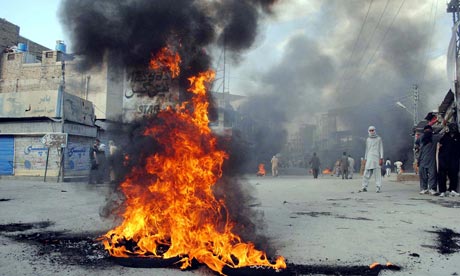
Pakistani protesters burn tyres in protest at the killing of shopkeeper Salman Ali in Quetta this week. Photograph: PPI images/Demotix/Corbis


While banned political groups preach hatred towards religious minorities in Pakistan's major cities, a conflict along sectarian lines is spreading across the country, even to areas not previously associated with violence. Having spent decades turning a blind eye to the calculated violence of groups with a clear agenda based on hatred and intolerance, Pakistan's government appears helpless in the face of continuous attacks on Shia Muslims and other minorities.....Continue Reading....

Wednesday, April 18, 2012

Shia Hazara Women On Target Killing In Quetta

MWM balochistan protest at alamdar road By Shia hazara Women

Aaj kamran khan ke saath - Balochistan's dire situation (18th April)

Message To Zardari In Sindhi From Hazara Women

Hazara students call for broad coalition in Balochistan


From the Newspaper | Mahvish Ahmad |

ISLAMABAD, April 16: The Hazara Student Federation (HSF) in the federal capital has spent the last month participating in seminars and organising protests, calling for a broad coalition between Baloch, Hazara and Pakhtun people in Balochistan.

“It makes no sense to stand divided when we all face the same threats and dangers. We have all been victim of violent kidnappings and killings, and the only way forward is to stand in solidarity,” says Sajjad Hussain Changezi, one of the members and spokespersons of the HSF.

The student federation calls for a political, non-violent resistance against elements that are threatening, kidnapping and killing members of all ethnic communities in Balochistan.

Waleed Umar, a Baloch youth and student, agrees with Changezi.

“We only have each other now. It is crucial that we support each other, said Umar, who participated and spoke at a protest organised by the HSF against a spate of killings of Hazaras in Balochistan on Saturday.

“Umar participated and spoke at the protest, putting his own life at risk. He is brave for having stood up in front of the Islamabad press club, side by side with us,” says Changezi.

“The truth is that the state bears a huge burden of the responsibility for the law and order situation in Balochistan. The Baloch accuse the military and intelligence agencies for extrajudicial kidnappings and killings in Balochistan.

And when it comes to the Hazaras, the continued presence of the Lashkar-i-Jhangvi in Quetta indicates that the state has either failed to protect us or is directly complicit in keeping them there.

The Pakhtuns are also in constant danger living in such a situation,” says Changezi.

More than 700 Hazaras have been killed in Balochistan since September 11, 2001.

“We have common enemies, and a common path. The only way we can resist the enormous threats that we stand against, is to stand together,” says Umar.

Quetta violence: Hazara protesters demand governor’s rule in Balochistan


By Our Correspondent
Published: April 18, 2012


Demonstrators condemned govt’s failure to protect their community. PHOTO: REUTERS/ FILE
QUETTA:

Scores of women took to the streets in Quetta on Tuesday to condemn the target killings of members of the Hazara community. The protesters demanded that governor‘s rule be imposed in Quetta, as the government had failed to curb violence against their community.

The procession, organised by Majlis Wahdatul Muslimeen (MWM), culminated at the Hazara graveyard in Quetta where they raised slogans against the government and law enforcement agencies for their failure to curb target killings.

MWM General Secretary Sayed Yusuf Agha said the provincial government was not sincere in maintaining law and order in Balochistan, where killers had a free hand.

“The Hazara community demands the imposition of governor rule in the province,” he said.

The women were carrying placards and banners inscribed with slogans like “Stop the genocide of the Hazara community. End target killing.”

The protesters offered Fateha at the graveyard for those killed in the recent wave of attacks against the community in the province.

The Hazara community has been protesting for the past one week demanding that the government take action against the target killers. As many as 19 people belonging to the community have been killed in targeted attacks in Quetta over the past one week.

Stringent security measures have been adopted in and around Quetta including large deployment of Frontier Corps (FC) personnel, police, Balochistan Levies personnel and other law enforcement agencies following the recent spate of target killings.

The government also extended a ban on pillion riding and the display of arms in the city. Hundreds of motorcyclists were detained over violating the ban.

Published in The Express Tribune, April 18th, 2012.