Azaranica is a non-biased news aggregator on Hazaras. The main aim is to promote understanding and respect for cultural identities by highlighting the realities they face on daily basis...Hazaras have been the victim of active persecution and discrimination and one of the reasons among many has been the lack of information, awareness, and disinformation.

Sunday, June 10, 2012

50 injured in blast near passenger bus

QUETTA: An explosion near a passenger bus on way from Mastung to Noshki wounded scores of passengers, Geo News reported.

Levies sources said that the blast occurred near the bus on way from Matung to Noshki at a place Darengra. Initially it could not be known as to whether the blast took place inside the bus or the explosives were planted on roadside.

More than 50 passengers were wounded as a result of the blast, according to initial report, while death also feared according to some information.

The injured being shifted to Mastung Civil Hospital.

جنایات کوچی ها در بهسود

Dr. Habiba Sarabi: Afghanistan's Peacemaking Governor (In Dari)

Friday, June 8, 2012

اقامتگاه استاد حاج محمد محقق در کابل

Young Asylum Seekers Arrive to ‘Nightmare’ Detention


By Neena Bhandari


From left to right, Ali Mohammadi (17) from Afghanistan, Hussain Akhlaqi (17) from Indonesia and Mujtaba Ahmadi (18) from Iran

Credit: Neena Bhandari/IPS

Buy this picture

SYDNEY, Jun 8, 2012 (IPS) - When Hussain Akhlaqi (17) arrived on Australian shores 11 months ago from Indonesia, on a boat carrying over 100 other asylum seekers, he was immediately placed in the Christmas Island immigration detention centre. Ali Mohammadi (17) from Afghanistan, and Mujtaba Ahmadi (18) from Iran, also endured a risky journey by sea only to meet the same fate.

Australia’s systematic use of remote, indefinite and mandatory detention of refugees or asylum seekers, even children, who arrive here without the proper documentation, set it apart from most other signatories to the 1951 United Nations Refugee Agency (UNHCR)’s Refugee Conventionand the 1967 Protocol relating to the Status of Refugees.

While many countries detain illegal immigrants for varying periods of time, Australia is probably the only country where detention is mandatory for adults and children while their case is being reviewed by the Department of Immigration and Citizenship – a process that can take up to months or sometimes years.

To mark the 20th anniversary of this unjustifiable policy, the International Detention Coalition(IDC), comprised of 250 members in 50 countries, has launched a global campaign to endimmigration detention of children.

"There is a growing recognition that immigration detention damages people as well as Australia’s reputation. There is no evidence that detention stops, reduces or deters boats (carrying asylum seekers) arriving on our shores. Detention, as in Europe, should only ever be used as a last resort because it is financially and (humanly) costly and not in the best interest of children and the vulnerable (refugees or the infirm)," IDC Director, Grant Mitchell, told IPS.

Last financial year, the Australian government spent over 772 million Australian dollars (757 million U.S. dollars) on running detention facilities. Meanwhile the Immigration Department has confirmed that its contract with Serco Australia Pty Ltd, a private company that operates detention centres, is now worth more than one billion Australian dollars, to be paid over a period of four years.

Devastating mental impacts

Hussain, who was fortunate to be released from detention after three months, told IPS, "I felt like a prisoner in the detention centre and I’ve been very depressed since."

Having lost his parents and all of his siblings – except a younger brother and an older sister – at the age of five, in the 2000 Taliban attack on his village in Bamiyan province, Hussain lived with his uncle who compelled him to leave school and work.

He finally paid a smuggler 15,000 dollars, raised by selling his sister’s jewellery, to get him out of the country. He endured a harrowing 40-day journey from Afghanistan to Dubai, Malaysia and Indonesia before finally reaching Australia.

Hussain now shares a small flat in Sydney with Ali and Mujtaba, whom he met in the Christmas Island detention centre. They find comfort in each other’s company.

"We have survived living in cramped spaces with little sleep and sometimes no food, undertaking dangerous voyages on old boats alone and (withstanding) the ‘disgrace’ of being in detention. It has been absolutely frightening," Ali, who came to Australia 10 months ago, told IPS.

The boys say they can’t stop thinking about their families and praying for the day they will be reunited with their surviving family members. Mujtaba, who was born a refugee in Iran to Afghan parents, said, "I keep asking why I was put in detention? I have done nothing wrong in fleeing from a bad situation, risking my life on a boat to seek refuge here.

"Though I am physically free after spending a year in detention, I am mentally still a prisoner. Each night, I take a sleeping pill otherwise I have nightmares."

Even after being released from detention, these children are often withdrawn, frightened, distraught with separation anxiety, and depressed. Many suffer from a high risk of mental illness and post- traumatic symptoms including distress, sleep and behavioural disturbances, suicidal thoughts and self- destructive behaviour.

Chief Executive Officer of the Refugee Council of Australia, Paul Power, told IPS, "A detention facility is no place for a child, let alone a vulnerable child whose life experiences have been shaped by conflict, war or persecution. We would like to see the Australian Government continue to move children out of detention facilities and into a community setting."

In violation of international law

There is now a large body of evidence to suggest that prolonged detention can have severely detrimental effects, especially on children who have experienced torture or trauma in their homeland.

The IDC campaign has drawn national and international pressure on this issue and forced the Australian Government to speed up the process of releasing more children from detention. According to the Department of Immigration and Citizenship, there were 4,329 people, including 463 youth under the age of 18 in various immigration detention facilities as of April 30 this year.

Since the campaign kicked off, the number of children in detention has dropped from 463 to 281. As Amnesty International Australia's Refugee Coordinator and spokesperson, Graham Thom, told IPS, "In practice Australia does try and release children quickly from detention, normally into some form of community detention. However, release remains at the discretion of the minister; if she/he chooses not to intervene they will be held in detention indefinitely".

Thom added, "This policy has consistently been found, both by the United Nations and domestic human rights agencies, to be in breach of Australia’s obligations under the Convention of the Rights of the Child in a number of respects. Article 3 clearly states that governments should act in the best interests of the child. This includes appropriate access to health care (Article 24), education (Article 28) and the right to play (Article 31). Each of these rights is seriously undermined for children in detention in Australia. Importantly, Article 37 highlights that children should not be arbitrarily deprived of their liberty and if they are deprived of their liberty, they should be able to effectively challenge this in court."

The mandatory detention policy also breaches Australia’s other international legal obligations. Article nine of the 1966 International Covenant on Civil and Political Rights (ICCPR), to which Australia is a party, prohibits arbitrary detention and provides that a detained person must be able to take proceedings before a court that can determine the lawfulness of detention and order release where detention is unlawful. The rights to liberty and freedom from arbitrary detention are also protected in Articles three (Right to Liberty) and nine (Prohibition on Arbitrary Detention) of the Universal Declaration of Human Rights.

A Joint Select Committee report on Australia’s immigration detention network released in March has recommended that, as a matter of policy, detainees be accommodated in metropolitan areas wherever possible, particularly children, families and those with special needs or complex medical conditions and that a uniform child protection code be implemented across the immigration system for children seeking asylum.

The IDC global campaign will focus on Greece this month and will then move to Poland, Mexico and the United States, Malaysia, South Africa and will wind up in Israel, where children in immigration detention is becoming a big issue.

(END)

CMC report says violence jumped up 350pc in Quetta


Usman ManzoorSaturday, June 09, 2012
From Print Edition

ISLAMABAD: Violence in Quetta increased by 350 percent during May 2012 as compared to preceding months and the security forces could kill only one militant during the month, reveals the monthly report of the Conflict Monitoring Centre (CMC).

“An unprecedented escalation of militant attacks in Quetta district of the troubled Balochistan province shows grim security situation but hand-tied security forces have restricted themselves only to defensive tactics. The militants killed 16 security forces personnel including an SSP and seven policemen but the security forces could eliminate only one militant during the month,” says the report released by the CMC, an independent research centre based in Islamabad. The report mentions that civilians remained the major victims of militant attacks in Balochistan during May 2012, as 51 out of 67 victims were civilians. Militant violence affected 19 out of total 30 districts of Balochistan during the month.

“Quetta was most affected district of the province as 43 percent (28 out of 65) militant attacks were recorded in the provincial capital. The worrying sign is that violence in Quetta increased 350 percent as compared to April when only 8 incidents of militant attacks were recorded. Average number of militant attacks in Quetta during first four months of the year was 12. An unprecedented level of increase in militant attacks in Quetta demands immediate response from counter insurgency mechanism of the provincial as well as central government,” the report says. The CMC statistics show that overall militant attacks in Balochistan once again surpassed Khyber Pakhtunkhwa and Fata and the militants have carried out more than ever attacks against forces. “Generally they use to hit soft targets and avoid forces but during May 2012 at least 15 attacks were carried out against police, Levies, and Frontier Constabulary.”

The CMC data shows the militants active in Balochistan are now consistently using sophisticated weapons against the government and public properties. “This trend is observed since start of the year 2011. Statistics of the month of May, however, show that more sophisticated weapons were used against police and Frontier Constabulary. The militants used 15 (missiles) IEDs in the month and half of them were used against forces.”

The CMC has already warned in its quarterly report that if concrete security measures were not taken against militants in this phase of militancy in Balochistan, the menace might enter into a no-return phase. The report says: “In May 2012, a senior police officer, SSP Shah Nawaz, was killed while the commissioner of Kalat narrowly escaped an assassination attempt. Seven policemen were killed and 9 wounded during the month. Police is not trained to fight organised militants.

Tolo Report; Ustad Muhaqiq Press Conference

جنایات کوچی ها در بهسود

Thursday, June 7, 2012

حمله به کاروان موتر های محمد محقق در میدان وردک


پنجشنبه ١٨ جوزا ١٣٩١ ساعت ١٩:٥٣

لحظات پیش کاروان موتر های حاجی محمد محقق عضو ولسی جرگه در ولایت میدان وردک مورد حمله طالبان قرار گرفت


یک منبع نزدیک به آقای محقق به خبرگزاری بخدی گفت که حدود یک ساعت پیش، کاروان از موتر های محمد محقق که از ولایت بامیان به طرف کابل در حرکت بود در ولایت میدان وردک مورد حمله قرار گرفت است


در این حمله یک موتر واژگون شده که در نتیجه چهار محافظ امنیتی محقق زخمی شده اند.
هنوز محل دقیق این حادثه معلوم نیست


حاجی محمد محقق پس از اینکه شب گذشته محل اقامت او در ولایت بامیان مورد حمله قرار گرفت، صبح امروز با طیاره به کابل آمد


منبع که با خبرگزاری بخدی صحبت می کرد گفت که تا هنوز معلوم نیست که وضع در محل بروز حادثه در ولایت میدان وردک چگونه است


گزارش خبرنگار شبکه نگاه از بهسود.تاریخ.7.جون.2012

Kuchi Taliban Attack on Behsud ; P 1


Kuchi Taliban offensive on Behsud ; P2


Kuchi Taliban attack on Behsud ; P3


Clashes reported near Haji Mohammad Mohaqiq House in Bamiyan

By KHUSHNOOD NABIZADA - Thu Jun 07, 10:59 am

According to reports the residence of Haji Mohammad Mohaqiq member of the Afghan House of Representatives was attacked by unknown gunmen in central Bamiya province on Wednesday night.

The report was confirmed by security personnel of Haji Mohammad Mohaqiq and said the incident took place around 10:30 pm local time.

The source further added no one was injured or killed following the clashes.

Provincial counter-criminal chief Chaman Khan said they have launched an investigation to find out the facts behind the attack.

Haji Mohammad Mohaqiq is one of the prominent political figure in Afghanistan. He is leading the Islamic Unity Party of Afghanistan (Hezb-e-Wahdat Islami Afghanistan) and is the chief of the justice and judiciary commission in Afghan parliament.

In the meantime local residents said there has no clashes near the residence of Haji Mohammad Mohaqiq.

Tuesday, June 5, 2012

EDITORIAL: Troubleshooting in Balochistan


Prime Minister (PM) Yousaf Raza Gilani and COAS General Ashfaq Parvez Kayani are in Balochistan on a two day visit, ostensibly as a ‘troubleshooting’ trip. On arrival in Quetta on Sunday, the PM was ‘greeted’ by another sectarian attack in the city, which killed four Shia Hazaras and one policeman, while another policeman was injured. The incident is a very good reflection of the state of affairs in Quetta, let alone the rest of the province. There are two separate issues to be tackled. One, the sectarian mayhem unleashed by the Lashkar-e-Jhangvi against the Shia Hazara community; two, the ongoing Baloch nationalist armed resistance. On the former, it is amazing that despite the plethora of Hazara killings in recent days, no effective measures have been taken to quell the mischief of the terrorist fanatics. Neither has the Hazara community been extended any security, nor has a single sectarian murderer been arrested. It is ironic, therefore, for the PM to ‘order’ the Balochistan government to improve law and order. This too, like so many other exhortations before it (including from the Supreme Court) is likely to disappear into thin air once the PM returns. On the Baloch nationalist armed struggle, the PM has persisted with his blinkered approach to the problem. This approach relies almost exclusively on offering jobs and educational opportunities to the youth of the province, in the hope that this would wean them away from contemplating translating the widespread sympathies of the youth in Balochistan for the insurgents into active participation in resistance activities. The approach is a continuation of the ‘philosophy’ underlying the Aaghaaz-e-Haqooq-e-Balochistan package, which sees the problems of the province in terms almost exclusively of economic underdevelopment and lack of opportunities. While no one can quibble with the good intent behind the package and its successor steps, the whole thrust misses the point. Unless and until the alienated leaders and forces in the mountains or in exile are approached through appropriate intermediaries, and a purely political problem solved through political means and a negotiated settlement (something even the COAS has advocated in the recent high powered meeting on Balochistan in Islamabad), eschewing in the process the resort to military force and the notorious ‘kill and dump’ policy, no amount of jobs or educational opportunities will in and by themselves bring peace and reconciliation to the troubled province. The PM has stated in Quetta that the government intends to talk to the angry Baloch leaders, but he neither explained how this desirable move would come about, nor is there so far any sign that the government has taken any initiative in this regard. It thus remains just talk so far.

Governments tend to say only what is favourable to them in situations like the one that confronts Balochistan, and skip the bitter truths. This can only be likened to the parable of the ostrich with his head in the sand. The PM claims that provincial autonomy (through the 18th Amendment) and the ownership of the Baloch people over their resources are settled issues. With due respect, this is stretching the truth to breaking point. And that too at a time when Baloch leaders like Brahmdagh Bugti are saying the time for conferences and talks on Balochistan’s future has come and gone. In these circumstances the tired refrain that all is well in the best of all possible worlds can only act as salt sprinkled on the Baloch people’s wounds. Such salt was liberally used by the IG Frontier Corps the other day when he, in time honoured fashion, pointed the accusatory finger at the ubiquitous ‘foreign hand’ in Balochistan. The PM has now taken up that refrain and characterised it as foreign powers eyeing the resources of the province. Those old enough to have lived through the debacle of 1971 will recall how the genuine grievances of the people of East Pakistan (now Bangladesh) were either ignored or painted as ‘foreign inspired’, with the tragic consequences that flowed from that state of denial. Although the two situations are not exactly alike, Balochistan’s strategic location and potential wealth can tempt some great powers. By adopting a strategy of on the one hand ‘decapitating’ the Baloch intelligentsia through a slow genocide, and on the other offering the sops of jobs and educational opportunities, the government is persuading no one that it has a firm grip on the situation, or even a reasonable chance of success. *

Letter to Catherine Ashton Regarding Her Visit to Pakistan

Published in Human Rights Watch

JUNE 4, 2012

Baroness Catherine Ashton


High Representative of the Union for
Foreign Affairs and Security Policy
Vice-President of the European Commission
European Union

Via facsimile: +32 2 299 60 87

Dear High Representative Ashton,

We are writing in regard to your visit to Pakistan this week. In a public statement on June 4, you emphasized that your visit to Pakistan is “an expression of the EU’s support for the consolidation of democracy in the country.” The EU-Pakistan five-year Engagement Plan requires the EU and Pakistan to “use their institutional contacts to strengthen cooperation and exchange expertise on the functioning of civilian democratic bodies and safeguarding fundamental human rights and opposing extremist intolerance.”

In light of the engagement plans and the stated aims of your visit, Human Rights Watch urges you in your exchanges with the Pakistani government to raise the following human rights concerns.

Extrajudicial Killings and Enforced Disappearances

Across Balochistan province since January 2011, at least 300 people have been abducted, killed, and their bodies left on roadsides, in acts commonly referred to in Pakistan as “kill and dump” operations. Balochistan has also seen an increase in targeted killings of opposition leaders and activists. While Baloch nationalist leaders and activists have long been targeted by the Pakistani security forces, since the beginning of 2011 human rights activists and academics critical of the military have also been killed. The surge in unlawful killings of suspected militants and opposition figures in Balochistan has taken human rights violations in the province to an unprecedented level.

Research by Human Rights Watch suggests that Pakistani security forces are responsible for most of these killings. Human Rights Watch has documented how Pakistan’s security forces, particularly its intelligence agencies, have often targeted for enforced disappearance ethnic Baloch suspected of involvement in the Baloch nationalist movement. Abductions are carried out in broad daylight, often in busy public areas, and in the presence of multiple witnesses. Victims are taken away from shops and hotels, public buses, university campuses, homes, and places of work.

In all the cases Human Rights Watch documented, even evident members of the security forces did not identify themselves or explain the basis for arrest or where they were taking those apprehended. Often instead they beat the victims and dragged them handcuffed and blindfolded into their vehicles.

Many of the victims, especially senior political activists, have been “disappeared” more than once. They have been abducted, held in unacknowledged detention for weeks or even months, released, and then abducted again. And sometimes enforced disappearances occur after the security forces have made several unsuccessful attempts at abducting a person before finally apprehending and disappearing the victim.

The southern port city of Karachi in Sindh province has also experienced an exceptionally high level of violence during the year, with some 800 persons killed. The killings were perpetrated by armed groups patronized by all political parties with a presence in the city.

In 2008, Pakistan decided to accede to the International Convention for the Protection of All Persons from Enforced Disappearance, but has yet to ratify this important treaty. Pakistan also agreed to implement international human rights obligations within Federally Administered Tribal Areas and refrain from detention that contravenes international standards of due process. Instead, Pakistan enacted the “Action in Aid of Civil Power Ordinance, 2011,” which retrospectively provides legal cover to detentions by the military since 2008. This regulation, which deprives citizens of a fair trial and an impartial tribunal and effectively legalizes detention without trial by intelligence agencies, violates both international human rights law and Pakistan’s constitution.

Regarding extrajudicial killings and enforced disappearances, the EU should urge the Pakistan government to:
Take all necessary measures to end enforced disappearances, extrajudicial killings, and arbitrary detentions, and fully investigate and prosecute as appropriate all persons, regardless of position or rank, who order or carry out such abuses.
Make public the names and whereabouts of detainees.
Provide immediate access by the International Committee of the Red Cross to all detainees the organization seeks to visit.
Charge detainees with a recognizable criminal offense and promptly bring them to trial before a court that meets international fair trial standards or release them.
Allow detainees access to lawyers and to communicate with family members.
Communicate publicly and formally with the agencies responsible for disappearances, extrajudicial executions, and other abuses, including the army, Inter Services Intelligence (ISI), Military Intelligence (MI), Intelligence Bureau (IB), Frontier Corps, police, and other law enforcement and intelligence agencies, ordering an end to abuses and facilitate criminal inquires to hold perpetrators accountable.
Ratify the International Convention for the Protection of All Persons from Enforced Disappearance.
Invite the United Nations Special Rapporteur on extrajudicial, summary or arbitrary executions to visit Pakistan.


Freedom of religion

Since 2008, religious minorities such as the Shia have faced increasingly high levels of insecurity and persecution. Pakistan’s elected government, however, has failed to provide protection to those threatened by extremists, or to hold those who commit serious crimes against religious minorities accountable.

Sunni militant groups, such as Lashkar-e Jhangvi, operate with impunity even in areas where state authority is well established, such as in Punjab province and Karachi. For instance, in 2010 Islamist militant groups murdered senior figures over their public support for amending the country’s often abused blasphemy laws. In September 2011, gunmen killed 26 members of the Hazara Shia community travelling by bus to Iran to visit Shia holy sites near the town of Mastung. Three others were killed as they took the injured to a hospital. Lashkar-e-Jhangvi claimed responsibility. On October 4, 2011, gunmen killed 13 and wounded 6 on a bus carrying mostly Hazara Shia who were headed to work at a vegetable market on the outskirts of Quetta in Balochistan. In 2012, the killings of Hazara Shia have continued unabated with over 30 killed in the month of April alone and over 350 Hazaras killed since 2008.

Members of the Ahmadi religious community also continue to be a major target for blasphemy prosecutions and are subjected to specific anti-Ahmadi laws across Pakistan. On May 28, 2010, Islamist militants attacked two Ahmadiyya mosques in the city of Lahore with guns, grenades, and suicide bombs, killing 94 people and wounding well over 100. Two men were captured during the attack, but the government has failed to make progress on their trial, seeking repeated adjournments from the court. Since the May 2010 attacks, there has been an intensification of a public hate campaign against Ahmadis.

Regarding freedom of religion, the EU should urge the Pakistan government to:
Investigate alleged human rights abuses by the Lashkar-e-Jhangvi and other militant groups and hold those responsible to account, particularly those that have committed multiple killings of Shia community members in Balochistan.
Take urgent measures to protect members of the Shia community and other vulnerable groups from militant groups in Balochistan and across Pakistan.
Repeal laws that discriminate against minorities including section 295(C) of the Penal Code (the Blasphemy Law) and section 298, which targets the Ahmadiyya community specifically.
Hold accountable individuals and groups responsible for inciting violence against Muslim and non-Muslim minorities.
Implement its 2008 commitment that “the statutes that could lead to discrimination against religious minorities would be reviewed.”
Invite the UN Special Rapporteur on freedom of religion and belief to visit Pakistan.


Freedom of Expression

The right to freedom of expression and information is under persistent pressure by militant groups, the judiciary, and by the Pakistan military and its intelligence agencies in the face of government inaction. Pakistan is widely considered to be one of the most dangerous countries in the world for journalists. At least six journalists were killed in Pakistan during 2012.

Even where the government has instituted accountability processes under public pressure, the results have not been encouraging. For instance, journalist Saleem Shahzad, a reporter for the Hong Kong-based Asia Times Online and the Italian news agency Adnkronos International, was tortured and killed after receiving repeated and direct threats from the military’s dreaded ISI agency. Following an international and domestic furor caused by the murder, a judicial commission was formed within days to probe allegations of ISI complicity. The commission concluded in its January 10, 2012 report to the government that the police failed to question military intelligence officials in its criminal investigation. However, the commission failed to meet the terms of its mandate by its inability to identify or hold accountable the perpetrators.

A climate of fear impedes media coverage of military and militant groups. Journalists rarely report on human rights abuses by the military in counterterrorism operations, and the Taliban and other armed groups regularly threaten media outlets over their coverage. Security forces have physically attacked media offices and are known to torture, kidnap, arbitrarily detain, beat, and coerce reporters working for local, regional, and national media.

Chief Justice Iftikhar Chaudhry and the provincial high courts effectively muzzled media criticism of the judiciary in 2011 through threats of contempt of court proceedings, as has been the case since Pakistan’s independent judiciary was restored to office in 2009.

Regarding freedom of expression, the EU should urge the Pakistan government to:
End the harassment, intimidation, use of coercion, violence, and other abuses against members of the media by state security forces.
Speak out against the judiciary’s use of “contempt of court” and “suo moto” proceedings to muzzle legitimate criticism and public debate on judicial conduct.
Investigate and prosecute as appropriate government officials implicated in abuses against members of the media.
Implement the following recommendations by the Saleem Shahzad Inquiry Commission through legislation:
All intelligence agencies should be made accountable through “parliamentary oversight.”
Document through institutional mechanisms, the intelligence agencies’ “interaction with the media.”


Death Penalty

Human Rights Watch, like the EU, opposes the death penalty in all circumstances as an inherently irreversible, inhumane punishment. A majority of countries in the world have abolished the practice. In June 2008, Human Rights Watch wrote to Prime Minister Yusuf Raza Gilani urging action to abolish the death penalty and to impose a moratorium pending abolition. In a meeting with Human Rights Watch the following month, Gilani agreed to enforce a moratorium on executions and to commute to life imprisonment the sentences of thousands of prisoners in Pakistan facing capital punishment. Soon after military ruler Gen. Pervez Musharraf was ousted from office in 2008, Pakistan imposed a widely hailed de facto moratorium on judicial executions.

However, the courts continue to hand down death sentences and Pakistan has still not commuted the death sentences of thousands of prisoners on death row as promised in 2008.

Regarding the Death Penalty, the EU should urge the Pakistan government to:
Immediately declare an official moratorium on judicial executions pending abolition of the death penalty.
Commute all death sentences to life imprisonment.


Thank you for your consideration. We would be pleased to discuss these issues with you at a later date.

Sincerely yours,

Lotte Leicht
EU Director

Ali Dayan Hasan
Pakistan Director

Published in Human Rights Watch

Monday, June 4, 2012

به سبب درگيرى ميان کوچيها و هزارها پنج تن زخمى شدند


خبرنگار ميرآقا صميمى & هادي غفارى.Jun 4, 2012 - 20:34


کابل (پژواک ١٥ جوزا ٩١): مسؤولين ولايت ميدان وردگ مى گويند که دو روز پيش از اثر درگيرى چندساعته ميان کوچيها و هزارها ،دست کم پنج تن مجروح گرديد.

شاهد الله شاهد سخنگوى والى ميدان وردگ امروز به آژانس خبرى پژواک گفت که درگيرى ميان کوچيها و هزارها ،دو روز پيش ساعت چهار عصر ميان دايميرداد و حصۀ اول ولسوالى بهسود در منطقۀ ((کيجاب)) به وقوع پيوست.

شاهد گفت که بعد از جنگ، ٢٠٠ سرباز اردوى ملى وپوليس ،ساعت ده شب به منطقه رفته که با رسيدن آنها به منطقه ،درگيرى خاتمه يافته بود و اکنون کدام مشکل در آن جا نيست.

قرار معلومات شاهد، در اين درگيرى که به سبب مشکلات گذشته ميان هر دو قوم در اين ولايت بوقوع پيوست،چهار کوچى ويک هزارۀ ساکن محل در آن مجروح شده اند.

در برخى مناطق ولايت ميدان وردگ ، از چند سال گذشته بدينسو بر سر علف چرها درگيريهاى ميان کوچيها و هزارها رخ داده اند، که تلفات نيز درقبال داشت.

يکتن از کارمندان شفاخانۀ ايمرجنسې درکابل نيز تاييد نمود که از درگيرى متذکره، سه مجروح کوچى به اين شفاخانه انتقال شده اند.

شاهد گفت که براى حل مشکل ،يک هئيت نيز از سوى مقام ولايت به منطقه فرستاده شده است.

سمونوال دارآب پيکار قوماندان امنيۀ ولسوالى حصۀ اول بهسود ،به آژانس پژواک گفت که عصر دو روز پيش ،درگيرى ميان کوچيها و باشنده گان مناطق چشمه توغى، دهن گرماب، گرماب و قلعه مرادخان اين ولسوالى بوقوع پيوست.

نامبرده مى گويد اين جنگ که تا ساعت هشت صبح امروز ادامه يافت ،سه باشندۀ منطقه کشته و دو تن شان مفقود اند.

منبع مى افزايد که در اين درگيرى ،يک مسجد، چهار دکان و ١٩ منزل نيز به آتش کشانده شده اند.

نامبرده مى گويد که نيروهاى امنيتى وارد منطقه شده و اکنون کدام مشکل وجود ندارد

Geo Reports-Quetta Firing-03 Jun 2012

Sunday, June 3, 2012

Should We Rebuild the Buddhas of Bamiyan?


Llewelyn Morgan

Lecturer in Classics at Brasenose College, Oxford

Posted: 04/06/2012 00:00
When you've spent 18 months writing a book calledThe Buddhas of Bamiyan, and - let's be honest - when you'd quite like to flog a copy or two, all the recent talk about reconstructing one of the colossal statues demolished by the Taliban can seem heaven-sent. Those 18 months were spent discovering that places don't come any more historically significant than Bamiyan.

In AD 629 the Buddhas were visited by Xuanzang, the great Chinese traveller sometimes described as the Marco Polo of the East: he left a precious account of their original, brightly-coloured decoration. Later they were celebrated wonders of the Islamic world, monuments of which it was said that there were "no equals in this world."

At the end of the 18th century an eccentric but influential British author proposed that Bamiyan was the Garden of Eden: a string of dropouts, spies, and Christian missionaries visited Bamiyan from British India in his wake, and though all of them found a place of breathtaking natural beauty, the earthly paradise proved more elusive. Even the destruction of the Buddhas in 2001 was connected in murky ways to the greatest historical turning-point of recent times, in New York later the same year....Continue Reading...


کوئٹہ فائرنگ، پولیس اہلکار سمیت چھ ہلاک


 اتوار 3 جون 2012


ایس ایس پی محمد انور نے کہا کہ ٹارگٹ کلنگ کے اس حملے میں ملزمان نے شیعہ مسلک سے تعلق رکھنے والوں کو نشانہ بنایا۔

بلوچستان کے دارالحکومت کوئٹہ میں فائرنگ کے ایک واقعہ میں ایک پولیس اہلکار سمیت چھ افراد ہلاک ہوئے ہیں۔

پولیس کے مطابق ہلاک ہونے والوں میں چار کا تعلق ہزارہ قبیلے سے ہے۔

خیال رہے کہ آج اتوار کو فائرنگ کا یہ واقعہ ایک ایسے وقت میں پیش آیا جب وزیراعظم گیلانی بلوچستان میں امن و امان بہتر کرنے کے لیے دو روزہ دورے پر کوئٹہ پہنچے ہیں۔

کوئٹہ سے بی بی سی کے نامہ نگار ایوب ترین کے مطابق اتوار کے روز کوئٹہ کے سرکی روڈ پر کیپری سنیما کے قریب موٹرسائیکل سواروں نے ویلڈنگ کی ایک دوکان پر فائرنگ کی جس کے نتیجے میں پانچ افراد ہلاک ہوگئے۔

ہلاک ہونے والوں میں چار کا تعلق ہزارہ قبیلے اور شیعہ مسلک سے تھا جبکہ ایک سنی تاجک ہے۔ فائرنگ کی آواز سنتے ہی گشت پر موجود پولیس کی گاڑی وہاں پہنچ گئی اور انہوں نے حملہ آوروں پر فائرنگ شروع کردی۔ جس کے جواب میں مسلح افراد نے بھی پولیس گاڑی پر فائرنگ کی اور نتیجے میں ایک پولیس اہلکار ہلاک جبکہ ایک زخمی ہوا ہے۔

ہلاک و زخمی ہونے والوں کو فوری طور پر سول ہسپتال کوئٹہ منتقل کر دیا گیا جہاں ڈاکٹروں نے ضروری کارروائی کرنے کے بعد لاشیں ورثاء کے حوالے کر دی ہیں۔

زخمی پولیس اہلکار کے مطابق پولیس کی فائرنگ سے دو حملہ آور بھی زخمی ہوئے جنہیں ان کے ساتھی ایک رکشہ میں ڈال کر لیے گئے جس پر پولیس نے شہر کی ناکہ بندی کر کے ملزمان کی تلاش شروع کر دی ہے اور تمام ہسپتال میں زخمیوں کی تلاش جاری ہے۔

علاقہ ایس ایس پی محمد انور نے کہا کہ ٹارگٹ کلنگ کے اس حملے میں ملزمان نے شیعہ مسلک سے تعلق رکھنے والوں کو نشانہ بنایا۔

وزیراعظم گیلانی کی کوئٹہ آمد


ٹارگٹ کلنگ کا واقعہ ایک ایسے وقت میں پیش آیا جب وزیراعظم سید یوسف رضاء گیلانی بلوچستان میں امن وامان کی صورتحال کا جائزہ لینے کے لیے دو روز ہ دورے پر کوئٹہ پہنچ گئے ہیں۔

وزیراعظم کوئٹہ میں امن وامان سے متعلق ایک اعلیٰ سطحی اجلاس کی صدارت کریں گے اور لاپتہ افراد کومنظرعام پر لانے اور ٹارگٹ کلنگ کے واقعات روکنے کے لیے تجاویز پر غور کریں گے۔

وزیراعظم کی کوئٹہ آمد کے موقع پر سکیورٹی کے سخت انتظامات کیے گئے ہیں۔

ائیرپورٹ سے لیکر گورنر ہاؤس تک تمام راستے کو سیل کر دیاگیا جس کے باعث عام لوگوں کو شدید مشکلات کا سامنا کرنا پڑا۔

یاد رہے کہ وزیراعظم نے گذشتہ روز سنیچر کو اسلام آباد میں ایک اجلاس میں حکم دیا تھا کہ بلوچستان میں تمام غیر رجسٹرڈ اور کالی شیشے والی گاڑیوں کے خلاف کارروائی کی جائے اس کے علاوہ انہوں نے فوری طور پر ان تمام گاڑیوں کی راہداریاں منسوخ کرنے کا حکم دیا تھا جو مختلف اداروں کی جانب سے جاری ہو چکیں تھیں۔

اس کے علاوہ دہشت گردی کے واقعات کو روکنے کے لیے قوانین میں ترمیم لانے کا بھی فیصلہ کیا گیا تھا۔

ARY New; Policeman among 6 killed in firing on Sirki Road

At least six dead in Quetta’s targeted killings


DAWN.COM 

QUETTA: At least six people, including a policeman, were killed in Quetta when unidentified armed men opened fire at a shop at Sarki road on Sunday, DawnNews reported.

Four of them were dead on the spot while the other two succumbed to their injuries during treatment at Quetta’s civil hospital.

The other shopkeepers left their shops and ran to save their lives, as the wave of panic had prevailed in the market, sources said.

The attack of targeted killing happened just before Prime Minister Yousuf Raza Gilani’s arrival in Quetta.

The prime minister was coming on a two-day visit of the province to discuss the law and order situation of the province.


Balochistan violence: Policeman among six killed in Quetta


By Web Desk
Published: June 3, 2012

QUETTA: At least six people, including one policeman, were killed when unidentified men on motorcycles opened fire on a shop on Sirki Road, Express News reported on Sunday.

Four victims were inside the shop whereas the other two victims were passersby, police sources said.

A heavy contingent of police reached the crime scene and cordoned off the area. A search operation is underway.

Bodies of the victims were shifted to Civil Hospital where relatives of the deceased staged protests.

Police sources said that this appeared to be an incident of target killing.

Earlier, two Balochistan Levies personnel were killed in an attack on a check post, and a Hazara community member was shot dead, in separate incidents of violence.

Saturday, June 2, 2012

As 108 drowned, they cried: 'Pray for us'


Natalie O'BrienJune 3, 2012


Lost ... Fatima Nekbakht and sons Mujtaba and Asif. Photo: Jessie Taylor

After a nine-month investigation, Natalie O'Brien reveals the true story behind the deaths of 105 asylum seekers and three crew - and the failure of Australian authorities to alert rescuers.

'There is a storm coming. There are big waves coming for us. Pray for us, pray for us.'' These were the terrified last words from among 105 Hazara asylum seekers as their boat sank in rough seas just hours into their voyage from Indonesia to Australia.

Passengers had called their friends back in Indonesia. They left the call open as they went to their deaths.
They called and called, but got no answers
Australia's bungles and cover-ups exposed

''There was just screaming and crying and the sound of waves crashing on the boat, as it went down, drowning the men, women, and children,'' said Nazir Hussein Rezai, whose sister and nephews were on board.
Advertisement: Story continues below


Lost .... the widow Golafroz with filmmaker Jessie Taylor. Photo: Jessie Taylor

''Some of the passengers had called their friends, and they did not switch off their mobile … Their friends had to listen to their dying moments. It kept going until the water silenced the phones.''

Nazir, now living in Rockhampton, learnt the fate of his sister Fatima nek Bakht and her sons, Mujtaba, 11, and Asif, 13, when he rang other asylum seekers in Indonesia desperately trying to find out why his family never arrived in Australia.

It was about midnight on Friday October 2, 2009, when the fishing boat slipped quietly out of an undisclosed Indonesian port and headed out to sea, bound for Christmas Island.

Also on board was Mirza Hussain Jaffari, 26, who called his family in New York from his mobile to say he was on the boat and on his way to Australia. He reassured them the boat was new. There was nothing to worry about. With him, he said, were three Indonesian crew and another 104 Hazara asylum seekers from Afghanistan, mainly families with children.

They sailed through the night down the Indonesian coast, trying to avoid detection. Little did they know their journey was being monitored by spies planted in the people-smuggling networks who were reporting to the Australian Federal Police. Their movements had already been the subject of intelligence reports to Australia for six days before they even boarded the boat.

By early the next morning, a secret report - now obtained by The Sun-Herald under freedom-of-information laws - was sent to the Customs and Border Protection Command headquarters in Australia. It advised that the boat, associated with a people smuggler known as Sajjad Hussein, had ''possibly'' departed and was heading for Christmas Island.

The weather in Jakarta that day was fine and 32 degrees. But the region had been rocked by devastating earthquakes and a tsunami in the two days before they left. Judging by the phone calls made from the boat that day, the further it travelled the rougher the seas became.

Scared and upset, some passengers phoned the boat's organiser in Indonesia, a man named Hijazi or Farman Ali, pleading with him to let the boat turn back. But the people smuggler ordered the captain to push ahead, passengers told their relatives in later phone calls.

As the boat was buffeted by the storm, there were many mobile phone calls made from the vessel indicating that it was still close to land. Among them was one from the boat to people on Christmas Island. A handwritten note, obtained under FOI from the Australian Maritime Safety Authority, revealed that some of the calls were ''overheard'' and reported to the authorities. But it has never been revealed whether police were tapping those calls or someone on Christmas Island was informing the authorities.

An official timeline obtained from Customs shows it was some time just before midday that Saturday that disaster struck. One of the spies associated with the organisers called their AFP contact and said the boat was in trouble and taking on water.

Such an emergency, a sinking boat with more than 100 people on board, should have triggered an immediate response - a referral to the Australian Maritime Safety Authority and a general call to any ships in the area to go to their aid. But it didn't.

Instead, as the FOI documents show, Australian Customs and Border Protection decided to ''commence usual SIEV [suspected irregular entry vessel] response to contact''. It added, in brackets: ''if it continues towards Christmas Island''.

Almost four hours passed before the potential tragedy was even flagged to maritime safety and a search-and-rescue mission was mounted. The nearest Australian navy boat at that point was 360 nautical miles away. It would be yet another three hours before an Indonesian navy boat reached the stricken boat's position - and apparently found nothing.

Among others aboard the fishing boat were two brothers, Mohammed and Karim. There was also a widow, Golafroz, and her son, 17-year-old Sajjad. They had been interviewed while they were still waiting to board a boat in Indonesia by the Australian lawyer turned filmmaker Jessie Taylor, for her documentary Between the Devil and the Deep Blue Sea. Golafroz told Taylor her husband and two other sons had died in Afghanistan. Fatima nek Bakht told Taylor the Taliban killed her husband and five of her children, so she had sold everything she owned to get out of Afghanistan and onto a boat that would take her and her surviving boys to safety.

While the passengers clung on, hoping they would be rescued, it was not until 3.32pm that the AFP and Customs agreed to tell maritime safety there was a life-threatening emergency and release the boat's co-ordinates. The almost four-hour delay was caused because the AFP and Customs did not know how to reveal they knew the boat was in trouble without revealing it was a tip-off from an AFP source in Indonesia.

The official timeline shows that when the maritime authority was told it immediately swung into action, emailing and faxing Coastwatch and the Indonesian search and rescue agency known as BASARNAS.

At first it was believed the boat was just 100 kilometres north of Christmas Island, but then the co-ordinates were given. They were very precise - 0655S 10458E. The position placed it in a three-square-kilometre radius near the Sunda Strait, and still just 17 nautical miles offshore from Java.

Indonesian search and rescue advised Australia's maritime safety that it would send an Indonesian navy boat to the location to search. But when it got there, seven hours after the AFP was tipped off, it sent a message back saying it ''could find no accident at that position''.

There was also a curious message sent to the Australian rescue co-ordination centre from Customs: ''Indons don't believe that situation is a SAR [Search and Rescue] situation, after investigations.''

However, by the accounts of relatives, passengers had sighted what they thought was an official Australian vessel. Not long before the boat appears to have sunk, relatives had received a call from passengers. They could see a ship and they thought it was the Australians coming to rescue them. The passengers said they were going to throw their mobiles overboard and would get in contact again once they reached Christmas Island.

It remains a mystery whose ship they saw and why it did not help.

That evening, the Australian embassy in Jakarta effectively called off the search by telling maritime safety it had been told by ''diplomatic channels'' the boat was no longer in a ''distress situation''. Border Protection aircraft flew surveillance flights from Christmas Island towards the boat's last reported position later that night and did report seeing ''numerous contacts [boats] detected in the search area, however no vessels detected in distress''.

But two days later, on October 5, and then again on October 7, the AFP again received secret information about the ''status of the venture'' and the intended arrival point and passed that to Indonesian police to try to find it. The AFP has never revealed what it was told. On October 27, the Indonesian police's people smuggling taskforce, known as SATGAS, detained in Jakarta the alleged smuggler Sajjad Hussein, also known by his nickname Pisshi. Last month the Australian case against Hussein collapsed. The Commonwealth Director of Public Prosecutions withdrew its application to extradite him. He was released by Indonesia and deported to Pakistan.

By early December, families were making frantic calls to the people smugglers, demanding to know what had happened to their relatives - only to be reassured that the boat had arrived safely in Australia and they should make the final payments. The network of smugglers then disappeared, and confused relatives began travelling to Indonesia and around Australia trying to locate the missing.

Back in Australia, says Taylor: ''Families and friends of passengers on the boat called me [from Indonesia] to say that a group of people had got on a boat which had never arrived anywhere, nobody had been heard from in weeks, and they'd heard rumours that it had been lost at sea … The worst seemed to be confirmed by the deafening silence from every passenger known to be on the boat.

''I found out the names of specific people who had been on the boat whom I'd met a few months earlier. … It just confirmed the arbitrariness of who makes it and who doesn't … It's a lottery, and it should not have to happen in such a terribly dangerous way.''

For Nazir Hussein Rezai, the nightmare of knowing what happened to his sister and nephews never ends. The Hazara, who fled Afghanistan leaving everything behind, only yesterday took email delivery of a photo of his sister and sons. It is at least something to remember them by.

Read more: http://www.smh.com.au/opinion/political-news/as-108-drowned-they-cried-pray-for-us-20120602-1zoix.html#ixzz1wi2Y1Oaco

A page from history; 10,000 Hazaras were sold


Shia man shot dead in Quetta


Mohammad Ali, who was targeted killed on Saryab Road, Quetta


QUETTA: A member of the Hazara community was gunned down and another shot injured near a bus stop on Sariab Road on Saturday. According to police, the victim, identified as Muhammad Ali, was travelling in a rickshaw when armed assailants, riding a motorbike, opened fire on him. Ali was killed on the spot while the rickshaw driver sustained injuries. Police rushed to the spot soon after the incident and cordoned off the area. Ali and the injured rickshaw driver were moved to Provincial Sandeman Hospital. The deceased was a Shia from the Hazara community. “The murder can be a case of sectarian target killing but it is very early to reach to conclusions. A case has been registered against unidentified persons and an investigation is underway,” a police official said. Separately, unidentified persons hurled three hand grenades at a house in Killi Geo area of Quetta. According to sources, the house is owned by Muhammad Rafiq. Windows of the house were broken and a car was also damaged in the attack. staff report

Daily Times

Friday, June 1, 2012

Hazaras at history's crossroads

Amir MateenFriday, June 01, 2012
From Print Edition

QUETTA: The dilemma of the Hazara's predicament is not that the solution is proving elusive, but that so far even the problem has not been fully understood. It’s a multifaceted issue. At a cursory glance, it appears a simple sectarian issue, but it isn’t. It is a critical element in resolving the larger Balochistan conundrum and one whose impact will be felt in Afghanistan, Iran and beyond.

The Hazara question is arguably a complex one. Hazara activists were asked at a seminar recently why they supported a separate province in the Hazara area of Pakhtunkhwa. It was difficult to explain to the supposedly learned members of the Islamabad elite that Hazara as a people had nothing to do with Hazara the area in Abbottabad.

Yet the human side of the issue first must be taken into consideration before delving into its strategic dimension. One cannot ignore the extent of the injustices that have been committed against the Hazaras in the last couple of decades.... Continue Reading... 

Thursday, May 31, 2012

The victory of the void, a defeat for the Taliban

The Bamiyan Buddhas will not be rebuilt, says Unesco. The architect Andrea Bruno proposes a scheme that focuses reverently on their absence

By Anna Somers Cocks. Conservation, Issue 236, June 2012
Published online: 31 May 2012
The empty niche of the Great Buddha in 2010. “The void is the true sculpture,” says Andrea Bruno (inset), Afghanistan’s most seasoned conservation architect

When Andrea Bruno, an architectural consultant to Unesco for the past 40 years, went back to the Bamiyan Buddhas, blown up in March 2001 by the Taliban, he immediately scrapped all ideas he might have had about some sort of replacement. “The void is the true sculpture,” he says. “It stands disembodied witness to the will, thoughts and spiritual tensions of men long gone. The immanent presence of the niche, even without its sculpture, represents a victory for the monument and a defeat for those who tried to obliterate its memory with dynamite.” ...Continue Reading...

Wednesday, May 30, 2012

Born Pakistani, he died a Hazara


Amir MateenThursday, May 31, 2012
From Print Edition

QUETTA: Major Shafaat died a sad broken man. Abandoned by his institution. Betrayed by childhood friends. Forsaken by his hometown. His only fault was to have been born different. A man with a flat nose and chinky eyes. An ethnic Hazara.

He lived a rich childhood frolicking up and down the Quetta streets with his Baloch, Pashtun, Punjabi and Hazara friends from school. Ethnicity did not matter at all in those days. Friends were—well—just friends. He was lucky that he was able to fulfill his ambition to join Pakistan Army. There is a long tradition among his community to join army dating back to 1830s when Captain Jacob—of Jacobabad fame—recruited Hazaras for the First Afghan war. Musa Khan joined Hazara Pioneers Regiment in 1904 as a sepoy and rose to become Pakistan’s Chief of Army Staff and West Pakistan Governor. Shafaat admired General Musa and Air Vice Marshal (Retd) Sharbat Changezi as his role models from his community.

Shafaat, now a major posted in Rawalpindi, volunteered to be posted to his hometown about three years ago. He thought he would be better off serving in Quetta—among dear friends and family. The city had changed drastically by then. He found his non-hazara bosom friends avoiding him. Some of them even showed hostility. “I felt it was just because I had a flat nose and chinky eyes like most descendants of Mongol Khan, “ he said visibly Irritated. Disheartened, he took a leave and got himself enrolled in Balochistan University’s Mass Communication Department. He found the antagonism there even worse. It was a double jeopardy: Pashtun students aligned to Sunni parties saw him as a Shia outcaste liable, as their posters suggest, to be killed; Baloch suspected him as an army infiltrator who had been sent to spy on them. Here is the heart-breaker: He was not trusted even by his army colleagues back at the Inter Services Public Relations (ISPR) offices. He was kept out of the local intelligence loop. A new commandant had issued instructions not to let him see even the army’s movement roster. He was absolutely dismayed.

Shafaat shared his pain with me while we were traveling the length and breadth of Balochistan during one of my earlier visits there a few months ago. In all we spent about 62 hours together but now it appears like an entire lifetime. I had requested the ISPR to give me an attachment so that I could visit army’s remote outposts to get their side of the story. To my luck—came along Shafaat who was part journalist because of his Mass Communication degree. A highly sensitive soul, he was definitely way more knowledgeable and objective than your typical army officer. We travelled through Bolan Pass, Sibbi, Dera Allah Rar, Kashmore to Dera Bugti and back exploring some of the most explosive places in Pakistan. We had all the time during our long travels, sometimes 13 hours straight, to discuss Balochistan, particularly Hazaras.

We stopped by at Kolpur just outside the Quetta valley where, he told me, his ancestors had come as coal miners to escape the excesses of Afghan King Abdur Rehman in the 1890s. Kol means a cap in which they received their days’ earning and Pur means abode—hence abode of the cap-wielding people. Even today, a majority of Hazaras works on menial jobs as miners and labourers. We saw in Mach coal mines down the way that they remain as sturdy and hard working as they were a century ago.

Shafaat was constantly receiving calls from his family. He laughed that his wife and children were worried not because he was travelling to such dangerous areas but because they feared he might be targeted as a Hazara. “I don’t blame them,” I remember him saying, “such has been our life lately; I also fear the same every time my daughter goes to school or my wife goes to bazaar.”

Hazara are an easy target because they are easily distinguishable from the other ethnic groups because of their Mongol features. Over 700 Hazara Shias have been killed in the last decade.

As many as 39 Hazaras died in the last 19 days. Last September, religious processions organized by the community were targeted twice killing around 50 people. Then came the Mastung carnage the same month. It is not just the staggering number of Hazaras killed but the brutality that was shown by killers.

A bus carrying Hazara pilgrims to Quetta was brutally assaulted. All the 26 men and boys aboard were taken out of the bus, lined up and shot, as their mothers, wives and sisters watched from inside. Unafraid, the assailants had insured that the highway was blocked on both ends when they conducted that ambush. Two more Hazara men were killed after being dragged out of their cars at a traffic light in Quetta the same evening.The total death toll for the day was over thirty dead and scores more injured. It was mourning for almost every other house among roughly half a million Hazaras as most of them are related through marriages.

Shafaat said he too was sometimes seen as a suspect as many in the community blame the army. The argument goes that if the ISI can kill dump hundreds of Baloch, why cannot they get hold of a bunch of religious fanatics. “I am a suspect for me colleagues, my friends and my community,” he said sadly. His family wanted him to move to Australia. Thousands of Hazaras have moved to Australia and Canada in the last few years. Some take grave risks. Hundreds have died in containers, crossing borders, others in ship wrecks. Over 300 people died off the coast of Java last December, most of them Hazaras. So desperate are people from this cruelty that they are willing to take every risk to get out of here.

Shafaat was not the one to leave. He was too much in love with the Community that had held him in suspicion, the army that had disappointed him and Quetta that had scorned him. He was a proud Hazara, khaki as well as a Quettawal. Shafaat got a call while he was explaining his affection for the three. He turned suddenly pale. Another attack on Hazaras had taken place. Six were shot dead execution style while drinking tea at one of the many roadside stalls in Quetta. One of them was his relative. He almost fainted, sweating profusely. Being a small expert in cardiac symptoms, I could see it was serious. I got him a doze of aspirins and brain relaxants and requested him to “take it easy.” Obviously, he was very sensitive about the whole thing. On my way back I also talked to his family to keep him calm and away from such news.

I got a call from his number 15 days later. A big ‘hello’ came out of my mouth, without realizing that it was his daughter. “So where’s your dad,” I chuckled. “He died today,” she replied.

He was only 32. A noble honest man, but born with a flat nose and chinky eyes. Maybe he deserved to die because he naively believed himself to be a Pakistani. But in today’s Pakistan, he was just a Hazara.

SIYASI MAKTOOBAT | WEEKLY AKHBAR-E-JEHAN, URDU MAGAZINE

An interesting piece about CM  of Balochistan. Is it another another joke by CM  OR just some fun loving guys, making some jokes with CM? Who knows?

SIYASI MAKTOOBAT | WEEKLY AKHBAR-E-JEHAN, URDU MAGAZINE

Pakistani journalist seeks asylum

From:The Australian
May 31, 2012 12:00AM


Human rights groups and journalists yesterday marked the first anniversary of the murder of Saleem Shahzad yesterday. Source:AP


A PAKISTANI journalist from the persecuted Shia Hazara community has sought asylum in Australia, saying he was forced to flee the country because of death threats from military-backed militants.

News of 38-year-old Amjad Hussain's plea for asylum emerged yesterday as journalists and human rights groups in Pakistan and internationally marked the first anniversary of the murder of Pakistani journalist Saleem Shahzad.

Shahzad's tortured body was found floating in an irrigation channel about 100km from the Islamabad, weeks after he expressed fears for his life and revealed he had received threats from the Inter Services Intelligence agency.


Shahzad, known to have impeccable contacts in Pakistan's security establishment and within Islamic militant groups, had raised ISI hackles with a series of stories exploring links between the two sides.

A commission of inquiry into his death failed to reach a conclusion and no one has been apprehended for his murder.

Amnesty International yesterday condemned that failure and said Shahzad's killing "highlighted the perils faced by journalists in Pakistan".

Pakistan remains one of the world's most dangerous countries for journalists with at least three killed in the past five months, and six last year.

Mr Hussain, who claims to have been a close friend and colleague of Shahzad, says he fled the country fearing he would meet a similar fate because of his reports on the sectarian and extra-judicial murders, disappearances and human rights abuses against the Hazara and other communities in Balochistan.

The province has been embroiled for decades in a bloody battle between Baloch nationalists and paramilitary forces. Human Rights Watch estimates more than 275 Hazaras (who adhere to the Shia Muslim faith) were murdered in targeted killings between 2008 and 2011 in Balochistan.

Mr Hussain is being held in West Australia's Curtin Detention Centre but says, despite the difficult conditions, he now feels "protected" from the Islamic terror groups that threatened his life.

"I didn't want to become another Saleem Shahzad," he said in an interview published in the Huffington Post. "I was not ready to move to a third city and still meet Shahzad's fate."

Mr Hussain was based in Balochistan for the English language news channel Dawn TV before transferring from the provincial capital Quetta to Islamabad in 2010 following death threats, and a narrow escape from a suicide attack.

But he claims the threats continued after he moved to the capital and last October he quit his job and fled the country.

Dawn TV's Quetta bureau chief Ali Shah confirmed yesterday Mr Hussain had faced threats and persecution because he was Hazara, but said he was not aware he had received threats because of his reporting.

"It's really simple. There's a sectarian problem in Quetta city. His life was in danger because he was a Shia Hazara," Mr Shah told The Australian.

An email written by Mr Hussain in January this year to his former Islamabad employers reveals his plans to seek asylum in Australia and his need for evidence to support his case of persecution.

Hazara man shot dead in Quetta

By Our Correspondent
Published: May 30, 2012


Mohammad Ali was on his way on a bicycle when unknown assailants fired at him.

QUETTA: A member of the Hazara community was shot dead near a roadside hotel on Joint Road, Quetta on Wednesday.

According to the police, the victim identified as Ali Mohammad, son of Gulam Ali Hazara, was travelling on his cycle when armed assailants riding on a motorbike opened fire at him. Mohammad was killed on the spot and his body was rushed to the Provincial Sandeman hospital for autopsy.

The victim was a Shia Muslim hailing from Marriabad, a Hazara dominated area.

Talking to The Express Tribune, a police official said that the murder could have been a case of sectarian target killing, but it was premature to make any conclusions. “A case has been registered against unknown persons and an investigation is underway.”

Cross Fire - 29th May 2012

Tuesday, May 29, 2012

No One Hears the Poor

Here in Kabul, Voices co-coordinator Buddy Bell and I are guests at the home of the Afghan Peace Volunteers (APV), where we've gotten to know four young boys who are being tutored by the Volunteers in the afternoons, having "retired" from their former work as street vendors in exchange for a chance to enter a public school. Five afternoons a week, Murtaza, Rahim, Hamid and Sajad wheel their antiquated bicycles into the APV "yard." They quickly shake the hand of each person present and then wash their feet outside the back door before settling into a classroom to study language, math and art, tutored in each subject by a different Volunteer. They've cycled here from school through heavy traffic, which worries their mothers, but the families cannot afford for the boys to take a public bus. ...Continue Reading... 

Monday, May 28, 2012

Afghan insurgents target safest province Bamiyan

By Mirwais Harooni

KABUL | Tue May 29, 2012 1:21am EDT

(Reuters) - Insurgents have stepped up attacks in the area thought to be Afghanistan's safest, the rugged central province of Bamiyan, moving into the region in a bid to undermine security ahead of the end-2014 exit from the country of most foreign combat troops.

Around 20 Taliban fighters from neighboring Baghlan province have crossed into Bamiyan and launched attacks in several districts, Bamiyan Police Chief General Juma Guldi Yardem told Reuters on Tuesday.

"They usually plant roadside bombs, lead attacks on security checkpoints and some have even launched suicide attacks on some government offices," Yardem said...Continue Reading...

Sunday, May 27, 2012

Message for all Hazaras


#Hazara rally welcomed at #OccupyPerth Oct 29 #afghanistan #pakistan

CM Raisani spends hours gazing at shoes as Balochistan burns


Sunday, May 27, 2012
From Print Edition

"QUETTA: Balochistan Chief Minister Nawab Aslam Raisani is a paradox. His admirers will tell you that he is a happy-go-lucky person “who will not say ‘no’ to you for anything that you might ask.”

Well, that could be a good trait as well as bad, depending on what one is asking. He’s got his unique, casual style that is amply posted on YouTube as Pakistan’s most funny videos. In one video he is trying to address a public gathering visibly stoned. He tries to mutter a few sentences then takes long — really long — pauses and finally collapses on stage. His media managers will tell you it was migraine but even a child can tell that it’s not. This style is reflected in everything around him. It seems his clowning around fits every other stakeholder in power."........

........"The province was already beset by sectarian and target killings that saw 1,388 people killed in the last four years, 434 of them from law enforcing agencies. In the ever-growing sectarian strife, 287 Hazaras, Shias, Hindus and Christians were targeted in 88 incidents. Tragedy gets lots in these figures. In this sleepy old town that was known for its beautiful, breezy evenings, everybody seems to be killing everybody else."........

"It’s not just the insurgency but the normal crime rate that has shot up. Criminals are having a field day in the absence of any governance. Murders have gone up from 636 in 2008 to 1,270 in 2011. Robberies have also shot from 240 to 386 in the same period. Kidnapping for ransom has increased from 181 to 421 and still growing into 2012. This has impacted businessmen particularly. Many do not wear good clothes or use good cars to avoid being identified as rich. The very soul of the city seems shattered. An extra stare by a stranger can sometimes cause shivers."......Continue Reading...

Friday, May 25, 2012

Threatened Pakistani Journalist Seeks Asylum in Australia

A Pakistani minority journalist being held at theCurtin Immigration Detention Centre, 40 kilometers southeast of Derby in West Australia, says he now feels "protected" from Islamic terrorist groups that had threatened to kill him in his home country.Amjad Hussain, 38, a print and broadcast journalist, was the only reporter from the often marginalizedHazara ethnic community working in Pakistan's mainstream media in Islamabad, the nation's capital. In less than a decade, extremist groups have killed nearly 600 Hazaras for practicing a Shia version of Islam in Sunni majority Pakistan. Hussain describes himself as a Hazara modernist, a secular professional who has come under attack for his ethnicity and for highlighting the human rights abuses committed by extremist groups and certain segments of the Pakistani security forces...Continue Reading...

Thursday, May 24, 2012

Moderate quake hits Balochistan

IANS
Islamabad, May 25, 2012

An earthquake measuring 5.1 on the Richter scale hit Pakistan's Balochistan province late on Thursday, a media report said.

The quake's epicentre was located some 90 km from Khuzdar district of Balochistan, reported Xinhua quoting Pakistan's ARY news channel. Tremors

were felt in different areas of the province, including Quetta city, Khuzdar and Kalat.

There was, however, no immediate report of any loss of life or property, said officials of seismic monitoring centre in Quetta, the provincial capital of Balochistan.

Quetta: One shot dead at Sariab Road


QUETTA: Unknown men gunned down a man at Sariab Road in Quetta on Thursday, Geo News reported.

According to police, the victim Ameer Mohammad, resident of Hazara Town, was on his way to work when unidentified men riding a motorcycle opened fire on him.

He was rushed to Bolan Medical Complex but he succumbed to his injuries on the way to hospital.

Police termed it a ‘target killing’ incident while the culprits managed to escape from the scene.

Wednesday, May 23, 2012

Another Hazara Targeted in Quetta


Picture of the Hazara labor, who was targeted killed by terrorist, this morning at Killi Chakar area of Sariab, Quetta. He was on his way to work, when armed men riding on motorcycle targeted him.  He was identified as Ameer Mohammad s/o Haji Hasan, a resident of Hazara Town.

Planned Extermination: Balochistan’s Shia Hazara Community

By Nadir Hassan 18 MAY 2012


Photo: AFP

You don’t need to travel to Balochistan to understand how it has been systematically separated from the rest of the country. There is a cell-phone company advertisement at the airport in Karachi showing off the breadth of its network. A thousand points of light illuminate most of the country. However, Balochistan is mostly shrouded in darkness.

It has now become a journalistic cliché for an outsider to breathlessly report on the diversity of a city and Quetta, Balochistan’s capital city, certainly is diverse. But what is truly astounding is how diversely militarised Quetta is. There is the XII Corps of the Pakistan Army stationed there, now headed by Lt Gen Aslam Khattak and moved to the city in 2004, just before the Baloch rebellion began. A base of the Pakistan Air Force is maintained at Samungali and the Frontier Corps headquarters in the province is also maintained in Quetta and headed by Major General Obaidullah Khattak. That the military presence in Balochistan has such a strong Pakhtun component is not coincidental, for reasons that will become apparent. In addition, it is hard to walk any place in Quetta that doesn’t have policemen from the provincial police force patrolling the streets. It’s as if Pakistan’s security establishment is playing the world-domination board game Risk and has decided the best strategy is to move all its pieces to one tiny area.

However, in the minds of locals, because of this overwhelming military presence, Quetta may be one of the most insecure places in the country. By now everyone knows that a separatist rebellion is exploding in the province; less attention is being given to an organised war against minorities in the province’s capital. The most systematic of these campaigns may be the one against its Shia Hazara community...Continue Reading..

Saturday, May 19, 2012

The Buddhas of Bamiyan by Llewelyn Morgan – review

The story of two Afghan sculptures, destroyed after a millennium and a half
Samanth Subramanian
guardian.co.uk, Friday 18 May 2012

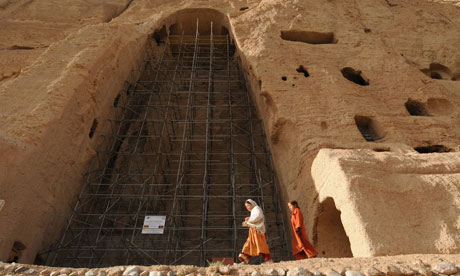
Afghan girls walk past the empty seat of one of the Buddhas in Bamiyan. Photograph: Shah Marai/AFP/Getty Images

In 2001, in a violent attempt to advance the cause of Islamic fundamentalism, a clutch of men empowered by the Taliban brought down a titanic pair of structures that loomed over their skyline. No lives were lost. The few people living near the Buddhas of Bamiyan, in central Afghanistan, were cleared out first, before anti-artillery weapons were trained on the sculptures, carved out of the russet cliffs of the Bamiyan valley. "These statues have been and remain shrines of unbelievers," a February 2011 edict from Mullah Omar had proclaimed. Their destruction was carried out with a rare and perverse vim. Failing at first to pulverise the Buddhas, the Taliban called in Pakistani and Arab engineers to finish the job. In The Places in Between, Rory Stewart observed that the Taliban had scorched a fresco on the ceiling of one of the caves that honeycomb the cliffs and then stamped boot-prints over the patina of soot. "This must have taken some effort, as the ceiling was 20 feet high....continue reading...

Thursday, May 17, 2012

Two Shia policemen shot dead in Quetta


Staff Report

QUETTA: Two police personnel, belonging to Shia sect, were shot dead and another two were injured in a targeted attack in the Sardar Karez area on Thursday.

Police said a police van was on a routine patrol when unidentified men opened fire on the vehicle in the Sardar Karez area of Eastern Bypass. Two officials, belonging to Hazara community, were killed on the spot and another two sustained injuries.

Heavy contingents of police and FC rushed to the spot and cordoned off the area. The bodies were shifted to the Bolan Hospital. The deceased were identified as constable Ghulam Murtaza and constable Sanaullah and those injured were ASI Muhammad Hussain and Constable Deen Muhammad. “It could be a case of sectarian killing,” a police official said. No group has claimed responsibility so far.

Balochistan Governor Zulfiqar Magsi and Chief Minister Aslam Raisani condemned the attack. A case has been registered against unidentified assailants.

Daily Times

BNP is gainst Sectarianism


The world turns a blind eye to killing of Hazaras in Pakistan

By Abdul Hekmat - posted Thursday, 17 May 2012

Imagine if the targets of Sydney’s drive-by shootings were not members of feuding bikie gangs but people singled out by virtue of their appearance to be shot dead while travelling to work by bus or car, shopping, attending a medical appointment or visiting relatives. It is beyond comprehension to imagine such a situation. Yet that is exactly what is happening to Hazaras in Pakistan. In recent years, armed terrorist groups have been targeting ordinary Hazara men, women and children on a weekly basis in Quetta, Pakistan. Over half a million Hazaras feel terrorized by these frenzy killings.

That is why on 10 May, over a thousand Hazara-Australians gathered in Canberra to protest against the systematic targeting of attacks on the Hazara community in Quetta, Pakistan. Men, women and children travelled by buses and cars from Melbourne, Adelaide, Brisbane and Sydney. Marching from the Australian Parliament House to the UN office and then the Pakistani embassy, they chanted ‘we want justice,’ ‘we want security,’ ‘Hazara rights are human rights,’ and ‘why is the UN silent’? ....Continue Reading...

Stone carvers defy Taliban to return to the Bamiyan valley

Afghan students learn the centuries-old skills that carved out the giant buddhas blown up by extremists

Emma Graham-Harrison in Bamiyan

Wednesday 16 May 2012

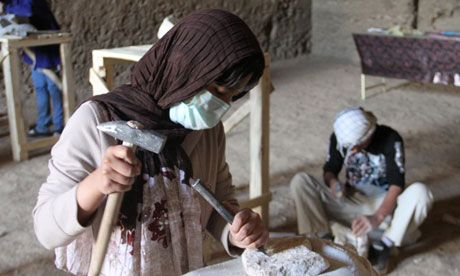
Afghans learning the skills of stone-working in the Bamiyan valley, where the Taliban blew up two giant buddhas in 2001.


Under perfectly carved niches that once held dozens of small buddha statues, the purposeful tap of chisel on stone echoed over the Bamiyan valley for the first time in centuries.

Twelve young Afghans had gathered to take the first tentative steps back towards a stone-working tradition that once made their home famous, at a workshop in a cave gouged out as a monastery assembly hall more than 1,000 years ago....Continue Reading...