Monday, July 23, 2012

Sunday, July 22, 2012
Taliban kill five private security guards in Wardak
By SAJAD - Sun Jul 22, 9:43 am
The dead bodies of at least five Afghan private security guards were recovered in central Maidan Wardak province of Afghanistan early Sunday morning.
According to reports the deceased security guards were working for a private security firm and were abducted by Taliban militants around 10:00 am local time on Saturday. The dead bodies of the security guards were left on a highway in Jalriz district.
Eyewitnesses in the area said signs of torture and bullet were seen on the bodies of the deceased security guards.
Anti-government armed militants groups and local security officials yet to comment regarding the reports.
The dead bodies of at least five Afghan private security guards were recovered in central Maidan Wardak province of Afghanistan early Sunday morning.
According to reports the deceased security guards were working for a private security firm and were abducted by Taliban militants around 10:00 am local time on Saturday. The dead bodies of the security guards were left on a highway in Jalriz district.
Eyewitnesses in the area said signs of torture and bullet were seen on the bodies of the deceased security guards.
Anti-government armed militants groups and local security officials yet to comment regarding the reports.
Saturday, July 21, 2012
Friday, July 20, 2012
VIEW: Quetta: on the brink of civil war —Liaquat Ali Hazara
Saturday, July 21, 2012
The citizens of Quetta should be admonished to refrain from providing any kind of support to the terrorists before it is too late for all
The exacerbating law and order situation in the southwestern capital of Balochistan province is alarmingly worrisome as more and more innocent people are being thrown on the altar of death on an almost daily basis. There is no iota of doubt that the Hazaras, in particular, have been the chief target of relentless ethno-religious attacks; however, the non-Hazara city-dwellers such as the Pashtuns, the Baloch, the Hindu and the Christian minorities and the Punjabis have also been targeted on one pretext or another.
The last week’s two separate incidents tell a gruesome tale as the Lashkar-e-Jhangvi’s imported butchers beheaded four innocent Shi’ites, who were abducted at the end of June. The video clip featuring these cold-blooded murders explicitly entailed that the perpetrators were talking in Pashto, symbolising the Taliban-style execution to spread fear and terror among the three million locals of the Quetta city. The second incident was, by no means, less tragic as a local Hindu trader was shot dead by unknown people. Apparently, the Hindu businessman was abducted for ransom; failure to reach an amicable bargain with the heirs ended up with the death of the abductee.
The annual reports of various human rights organisations, viz., Amnesty International, Human Rights Watch, Human Rights Commission of Pakistan and the Foreign and Commonwealth Office have blatantly expressed grave concern over the safety and protection of minorities in Pakistan. Special sections have been incorporated into these reports to highlight the persecution of Hazaras as well as that of the Hindus, the Christians and the Ahmadi minorities.
All sections of society agree that the intelligence agencies are involved in perturbing the law and order situation in Quetta for ulterior motives. Political analysts, intellectuals, columnists, members of civil society and the human rights organisations frequently express their reservations about the aggravating security situation in Quetta. The Chief Justice of Pakistan, Iftikhar Muhammad Chaudhry, has also shown his displeasure about the infamous role of the secret agencies in Quetta.
The bold statement of the recently sworn in Prime Minister Raja Pervez Ashraf, while presiding over a high-level meeting in Islamabad last month after taking charge of the post of chief executive from his predecessor; also acknowledged the involvement of federal agencies in the worsening situation of Balochistan and, in particular, Quetta.
The federal government and the judiciary’s highest office-bearers’ concerns convey their inability to harness those very departments whose main responsibilities are providing round-the-clock intelligence reports to the relevant quarters to improve the law and order situation rather than destabilising it. The previous rulers, who let the cat out in the late 1970s, created a huge challenge for all governments, including the incumbent one, to tame this blood-sucking monster. The main stakeholders in Balochistan have realised what the motive of the intelligence agencies is. The targeted attacks against the Hazaras in Quetta, the abduction and merciless killings of other minorities in the province, the mysteriously planted bomb blasts in and around seminaries, the clueless murders of prayer leaders of Sunnis and the latest add-on of Taliban-style beheading of the Shi’ite Muslims echo too much of a sound of civil war in the province.
Various Quetta-based political and social organisations working for the Hazaras, their chieftain, Sardar Sadaat Ali Hazara, and human rights activists have started uttering clearly that they are too exhausted to bury the bullet-riddled corpses routinely. Simultaneously, they point fingers at the dubious role of the intelligence agencies while suspicions rise manifold when the federal and provincial governments show apathy towards taking preventive measures to minimise human losses. The Hazara youths are enraged, while growing pressure on their elders to curb them from taking illegal steps is becoming less effective.
In the entire 13 years since the Hazaras first faced the attacks on their community members in 1999, the overall law and order situation remained intensely perturbed, especially for them, even though the Pashtun stakeholders own heavy investments in the form of shops, markets and local businesses. However, the Baloch are mostly populated in the suburbs of Quetta city; they too share equal socio-political interests in the city as well as in the province. Surprisingly, the nationalists’ political leadership of the Pashtun and the Baloch has been content with verbal condemnations of the brazen attacks of targeted killings on the Hazaras, while showing almost no practical support and solidarity with these oppressed people. The Hazaras term these condemnations devoid of genuine interest to take pragmatic steps for a solution.
I have quite often pondered what may restrict this stratum of society from openly denouncing these incidents and showing the dedication to help curb the menace. I frequently get the feeling that the main political leadership of the Pashtun and Baloch may think that the fire burning in their neighbourhood is of no concern to them. Mixed emotions among them may persist as though their neighbours must extinguish it themselves. The hard fact remains that the foreign elements-cum-imported target killers are making hectic efforts to provoke ethno-religious conflict in the entire Quetta city. Although the Pashtun and Baloch can clearly perceive the dangers of the fire spreading to their own houses, the obvious signs of a smokescreen will not at all save them from its overwhelmingly large-scale destruction.
If they can truly understand that hidden hands are trying to pit the Hazaras against the Pashtuns, Baloch, Punjabis and vice versa, then it is high time they openly came forward and preached to their fellow communities to thwart all conspiracies of civil war in Quetta.
Under no circumstances can the target killers execute their killing spree in the city successfully unless they have the full moral, financial and logistical support of the locals. When the assassins, in broad daylight, infiltrate the narrow and congested lanes and bazaars of Quetta, target-kill their prey and disappear smoothly, it is evident that the locals harbour them in nearby havens. When terrorists kill people in crowded areas such as Spinni Road, Seriab Road, Akhtarabad, McCongi Road, Podkilli Chowk, Hazar Ghanji, it reveals that they have the full support of the locals to hide in their dens comfortably after completing their tasks. The aforesaid areas are densely populated by both the Pashtun and Baloch who will have to be preached in a clear tone that terrorists would go away once they accomplished their goals but the locals will have to co-exist with one another for centuries. One particular ethnicity is in the line of severe fire for years, and it may erupt like a volcano any time, bringing unimaginable catastrophe to the whole city.
The Pashtun and the Baloch nationalist parties must take a clear stance on persecution of the Hazaras, and the citizens of Quetta should be admonished to refrain from providing any kind of support to the terrorists before it is too late for all.
The writer is a London-based freelance journalist, and the chairperson of a political organisation, known as Hazara United Movement (HUM)
The citizens of Quetta should be admonished to refrain from providing any kind of support to the terrorists before it is too late for all
The exacerbating law and order situation in the southwestern capital of Balochistan province is alarmingly worrisome as more and more innocent people are being thrown on the altar of death on an almost daily basis. There is no iota of doubt that the Hazaras, in particular, have been the chief target of relentless ethno-religious attacks; however, the non-Hazara city-dwellers such as the Pashtuns, the Baloch, the Hindu and the Christian minorities and the Punjabis have also been targeted on one pretext or another.
The last week’s two separate incidents tell a gruesome tale as the Lashkar-e-Jhangvi’s imported butchers beheaded four innocent Shi’ites, who were abducted at the end of June. The video clip featuring these cold-blooded murders explicitly entailed that the perpetrators were talking in Pashto, symbolising the Taliban-style execution to spread fear and terror among the three million locals of the Quetta city. The second incident was, by no means, less tragic as a local Hindu trader was shot dead by unknown people. Apparently, the Hindu businessman was abducted for ransom; failure to reach an amicable bargain with the heirs ended up with the death of the abductee.
The annual reports of various human rights organisations, viz., Amnesty International, Human Rights Watch, Human Rights Commission of Pakistan and the Foreign and Commonwealth Office have blatantly expressed grave concern over the safety and protection of minorities in Pakistan. Special sections have been incorporated into these reports to highlight the persecution of Hazaras as well as that of the Hindus, the Christians and the Ahmadi minorities.
All sections of society agree that the intelligence agencies are involved in perturbing the law and order situation in Quetta for ulterior motives. Political analysts, intellectuals, columnists, members of civil society and the human rights organisations frequently express their reservations about the aggravating security situation in Quetta. The Chief Justice of Pakistan, Iftikhar Muhammad Chaudhry, has also shown his displeasure about the infamous role of the secret agencies in Quetta.
The bold statement of the recently sworn in Prime Minister Raja Pervez Ashraf, while presiding over a high-level meeting in Islamabad last month after taking charge of the post of chief executive from his predecessor; also acknowledged the involvement of federal agencies in the worsening situation of Balochistan and, in particular, Quetta.
The federal government and the judiciary’s highest office-bearers’ concerns convey their inability to harness those very departments whose main responsibilities are providing round-the-clock intelligence reports to the relevant quarters to improve the law and order situation rather than destabilising it. The previous rulers, who let the cat out in the late 1970s, created a huge challenge for all governments, including the incumbent one, to tame this blood-sucking monster. The main stakeholders in Balochistan have realised what the motive of the intelligence agencies is. The targeted attacks against the Hazaras in Quetta, the abduction and merciless killings of other minorities in the province, the mysteriously planted bomb blasts in and around seminaries, the clueless murders of prayer leaders of Sunnis and the latest add-on of Taliban-style beheading of the Shi’ite Muslims echo too much of a sound of civil war in the province.
Various Quetta-based political and social organisations working for the Hazaras, their chieftain, Sardar Sadaat Ali Hazara, and human rights activists have started uttering clearly that they are too exhausted to bury the bullet-riddled corpses routinely. Simultaneously, they point fingers at the dubious role of the intelligence agencies while suspicions rise manifold when the federal and provincial governments show apathy towards taking preventive measures to minimise human losses. The Hazara youths are enraged, while growing pressure on their elders to curb them from taking illegal steps is becoming less effective.
In the entire 13 years since the Hazaras first faced the attacks on their community members in 1999, the overall law and order situation remained intensely perturbed, especially for them, even though the Pashtun stakeholders own heavy investments in the form of shops, markets and local businesses. However, the Baloch are mostly populated in the suburbs of Quetta city; they too share equal socio-political interests in the city as well as in the province. Surprisingly, the nationalists’ political leadership of the Pashtun and the Baloch has been content with verbal condemnations of the brazen attacks of targeted killings on the Hazaras, while showing almost no practical support and solidarity with these oppressed people. The Hazaras term these condemnations devoid of genuine interest to take pragmatic steps for a solution.
I have quite often pondered what may restrict this stratum of society from openly denouncing these incidents and showing the dedication to help curb the menace. I frequently get the feeling that the main political leadership of the Pashtun and Baloch may think that the fire burning in their neighbourhood is of no concern to them. Mixed emotions among them may persist as though their neighbours must extinguish it themselves. The hard fact remains that the foreign elements-cum-imported target killers are making hectic efforts to provoke ethno-religious conflict in the entire Quetta city. Although the Pashtun and Baloch can clearly perceive the dangers of the fire spreading to their own houses, the obvious signs of a smokescreen will not at all save them from its overwhelmingly large-scale destruction.
If they can truly understand that hidden hands are trying to pit the Hazaras against the Pashtuns, Baloch, Punjabis and vice versa, then it is high time they openly came forward and preached to their fellow communities to thwart all conspiracies of civil war in Quetta.
Under no circumstances can the target killers execute their killing spree in the city successfully unless they have the full moral, financial and logistical support of the locals. When the assassins, in broad daylight, infiltrate the narrow and congested lanes and bazaars of Quetta, target-kill their prey and disappear smoothly, it is evident that the locals harbour them in nearby havens. When terrorists kill people in crowded areas such as Spinni Road, Seriab Road, Akhtarabad, McCongi Road, Podkilli Chowk, Hazar Ghanji, it reveals that they have the full support of the locals to hide in their dens comfortably after completing their tasks. The aforesaid areas are densely populated by both the Pashtun and Baloch who will have to be preached in a clear tone that terrorists would go away once they accomplished their goals but the locals will have to co-exist with one another for centuries. One particular ethnicity is in the line of severe fire for years, and it may erupt like a volcano any time, bringing unimaginable catastrophe to the whole city.
The Pashtun and the Baloch nationalist parties must take a clear stance on persecution of the Hazaras, and the citizens of Quetta should be admonished to refrain from providing any kind of support to the terrorists before it is too late for all.
The writer is a London-based freelance journalist, and the chairperson of a political organisation, known as Hazara United Movement (HUM)
Thursday, July 19, 2012
Afghanistan insurgency threatens previously peaceful Bamiyan province
Concerns growing over violence in central highland province after two bombs killed nine police officers earlier this month
Emma Graham-Harrison in Kabul
guardian.co.uk, Thursday 19 July 2012 08.25 EDT
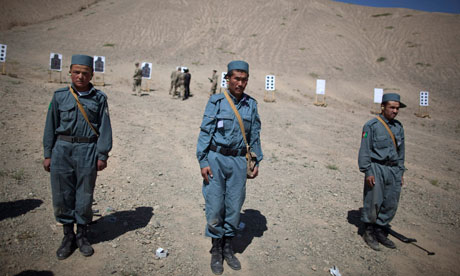
Afghan police officers train at a firing range in the central province of Bamiyan. Photograph: Ahmad Masood/REUTERS
The central highland province of Bamiyan has long been an island of security in the rising tide of Afghanistan's insurgency, largely insulated from the blasts and gunfire that have become commonplace across the rest of the country by its geography and a fierce strain of anti-Talibansentiment.
But concerns are growing over the government's ability to hold off insurgents in the region after two massive roadside bombs, just five days apart, killed nine police officers earlier this month.
It was an unprecedented toll for the area, and raised fears that violence will escalate as foreign troops withdraw.
The officers who died in two attacks on 3 and 8 July were the first Afghan casualties in Bamiyan since 2008, when a bomb killed a single policeman, according to Mohammad Ali Lakzi, the head of operations and archives for the provincial police force. A New Zealand soldier was also shot dead in 2010.
The area has remained so secure that it was chosen last summer to launch a gradual nationwide handover from Nato troops to Afghan forces, even though the nearest soldiers are in the next province. Armed police are the only security forces and they rarely have to make use of their guns.
But the people of Bamiyan have bitter memories of massacres in their valleys by Taliban troops, shortly before the hardline Islamists were ousted in late 2001, and the destruction of two giant Buddha statues that had gazed serenely out of a cliff for over a millennium.
And so the July bombs that detonated under two police vehicles have sent a chill through the province. The first set of buried explosives killed four officers and injured two, the second killed five.
"In the past few years we never faced such an incident," said the provincial police chief, Juma Guldi Yaardam, who has more than 1,000 officers at his command but says he needs army support in tackling the insurgent threat spilling over from less peaceful neighbouring areas – particularly Baghlan, Parwan and Wardak provinces.
"These provinces are unsafe and we have big concerns about the future. We think we need more troops to ensure good security for the borders."
The north-eastern district where the deadly bombs were buried has long been the riskiest part of Bamiyan, but the attacks were unusually bold.
"They were unprecedented in terms of the death toll and getting their targets," said a Foreign Official familiar with the province. The deaths rekindled concerns sparked by the kidnapping and murder of the head of the provincial council on the road from Kabul last year.
"Most of the province, in an Afghan context, is safe, but the north-east has this problem … Who knows whether this is the start of a pattern or not," the official added. "People are maybe getting a bit more nervous."
The provincial governor, the only woman in Afghanistan to run one of the 34 regional administrations, says the police are ill-prepared to handle battle-hardened insurgents.
"The number of guns that our police have is not really sufficient," Habiba Sarabi said in a telephone interview, in which she also stressed most of her province was still safe.
"Our military needs some more supplies, some more support for training and equipment."
Insurgents have attacked civilian supplies, including tankers of fuel, on the critical road through the northeast, and there are insurgents active along a southern route too. The violence pushes up prices in Bamiyan and limits travel out of the isolated province, she said.
"When they want to travel to Kabul … it's really bad for them to take either road," Sarabi said. "Sometimes even their gasoline trucks or some other supplies are stopped by these insurgents and also some of them have been burned, so this ensures the people of Bamiyan are suffering and not happy."
Most of the unrest is from small, mobile groups of less than 20 insurgents that cross into Bamiyan for brief attacks or to bury an IED before disappearing back into lawless areas where the government has little or no reach.
There are more checkpoints on the roads now as a stop-gap solution, but Sarabi said more co-ordination with officials in the troubled provinces, and help from the Afghan army, is critical to tackling the violence long-term.
The negotiations leading up to the security handover from New Zealand forces last July included a request for soldiers, but so far they have not been provided. A spokesman for the Afghanistan ministry of defence declined to comment on whether that might change.
"As a strategy of the ministry of defence, we check if there are threats and send forces where they are needed," said spokesman General Zahir Azimi.
Additional reporting by Mokhtar Amiri
guardian.co.uk, Thursday 19 July 2012 08.25 EDT
Afghan police officers train at a firing range in the central province of Bamiyan. Photograph: Ahmad Masood/REUTERS
The central highland province of Bamiyan has long been an island of security in the rising tide of Afghanistan's insurgency, largely insulated from the blasts and gunfire that have become commonplace across the rest of the country by its geography and a fierce strain of anti-Talibansentiment.
But concerns are growing over the government's ability to hold off insurgents in the region after two massive roadside bombs, just five days apart, killed nine police officers earlier this month.
It was an unprecedented toll for the area, and raised fears that violence will escalate as foreign troops withdraw.
The officers who died in two attacks on 3 and 8 July were the first Afghan casualties in Bamiyan since 2008, when a bomb killed a single policeman, according to Mohammad Ali Lakzi, the head of operations and archives for the provincial police force. A New Zealand soldier was also shot dead in 2010.
The area has remained so secure that it was chosen last summer to launch a gradual nationwide handover from Nato troops to Afghan forces, even though the nearest soldiers are in the next province. Armed police are the only security forces and they rarely have to make use of their guns.
But the people of Bamiyan have bitter memories of massacres in their valleys by Taliban troops, shortly before the hardline Islamists were ousted in late 2001, and the destruction of two giant Buddha statues that had gazed serenely out of a cliff for over a millennium.
And so the July bombs that detonated under two police vehicles have sent a chill through the province. The first set of buried explosives killed four officers and injured two, the second killed five.
"In the past few years we never faced such an incident," said the provincial police chief, Juma Guldi Yaardam, who has more than 1,000 officers at his command but says he needs army support in tackling the insurgent threat spilling over from less peaceful neighbouring areas – particularly Baghlan, Parwan and Wardak provinces.
"These provinces are unsafe and we have big concerns about the future. We think we need more troops to ensure good security for the borders."
The north-eastern district where the deadly bombs were buried has long been the riskiest part of Bamiyan, but the attacks were unusually bold.
"They were unprecedented in terms of the death toll and getting their targets," said a Foreign Official familiar with the province. The deaths rekindled concerns sparked by the kidnapping and murder of the head of the provincial council on the road from Kabul last year.
"Most of the province, in an Afghan context, is safe, but the north-east has this problem … Who knows whether this is the start of a pattern or not," the official added. "People are maybe getting a bit more nervous."
The provincial governor, the only woman in Afghanistan to run one of the 34 regional administrations, says the police are ill-prepared to handle battle-hardened insurgents.
"The number of guns that our police have is not really sufficient," Habiba Sarabi said in a telephone interview, in which she also stressed most of her province was still safe.
"Our military needs some more supplies, some more support for training and equipment."
Insurgents have attacked civilian supplies, including tankers of fuel, on the critical road through the northeast, and there are insurgents active along a southern route too. The violence pushes up prices in Bamiyan and limits travel out of the isolated province, she said.
"When they want to travel to Kabul … it's really bad for them to take either road," Sarabi said. "Sometimes even their gasoline trucks or some other supplies are stopped by these insurgents and also some of them have been burned, so this ensures the people of Bamiyan are suffering and not happy."
Most of the unrest is from small, mobile groups of less than 20 insurgents that cross into Bamiyan for brief attacks or to bury an IED before disappearing back into lawless areas where the government has little or no reach.
There are more checkpoints on the roads now as a stop-gap solution, but Sarabi said more co-ordination with officials in the troubled provinces, and help from the Afghan army, is critical to tackling the violence long-term.
The negotiations leading up to the security handover from New Zealand forces last July included a request for soldiers, but so far they have not been provided. A spokesman for the Afghanistan ministry of defence declined to comment on whether that might change.
"As a strategy of the ministry of defence, we check if there are threats and send forces where they are needed," said spokesman General Zahir Azimi.
Additional reporting by Mokhtar Amiri
Subscribe to:
Comments (Atom)